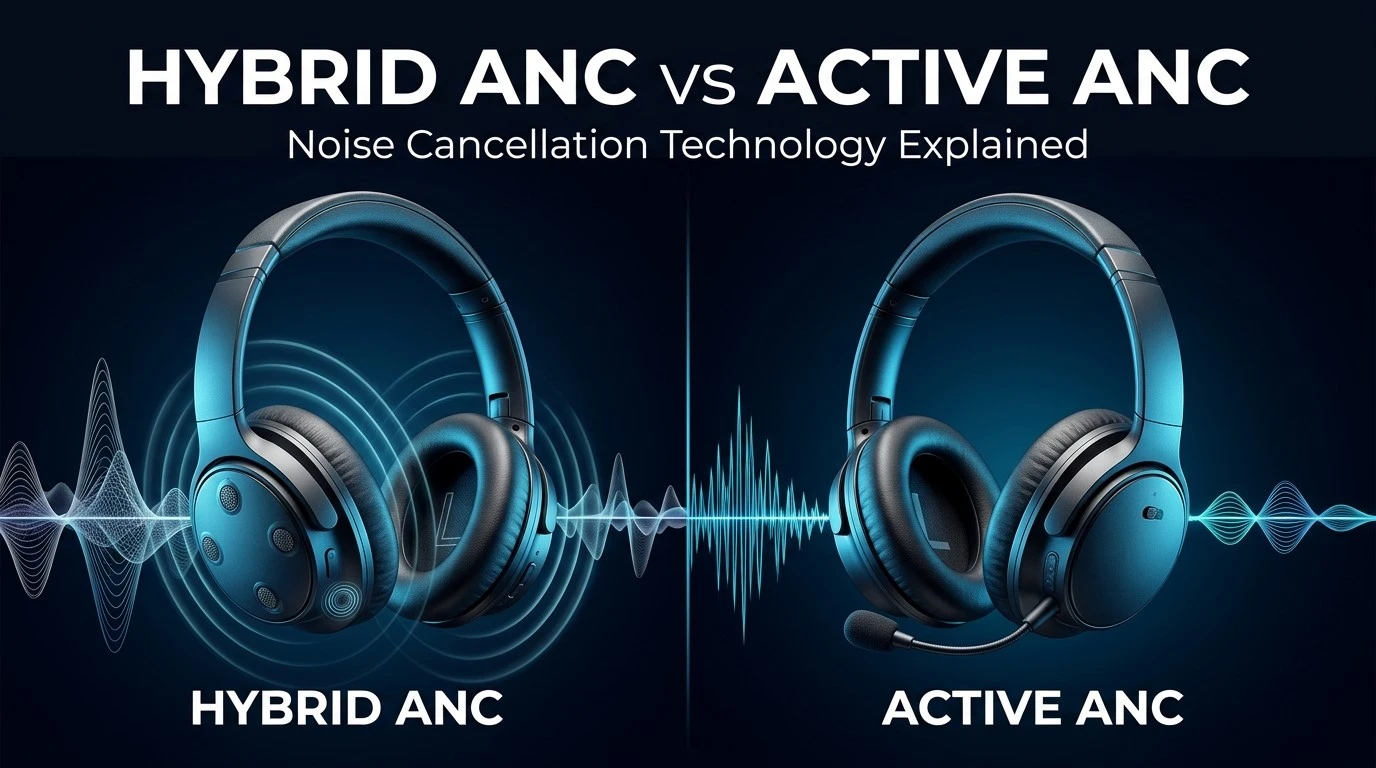
Choosing the right noise-cancelling headphones or earbuds can make a significant difference in how you enjoy music, podcasts, movies, and phone calls. However, when shopping for audio products, you may encounter terms such as Hybrid ANC and Active ANC that can be confusing. Understanding Hybrid ANC vs Active ANC is essential if you want to purchase headphones that effectively reduce unwanted background noise without spending more money than necessary.
Active Noise Cancellation (ANC) is a technology that uses microphones and electronic processing to reduce surrounding sounds. Hybrid ANC takes this technology further by combining multiple microphone placements to detect noise from both inside and outside the ear. This difference can influence how well headphones handle airplane engines, traffic, office conversations, and other everyday distractions.
Although both technologies aim to create a quieter listening experience, they do not necessarily deliver identical results. In this guide, we will compare Hybrid ANC and Active ANC, explain their advantages and disadvantages, examine their real-world performance, and help you choose the right option for your lifestyle, listening habits, and budget.
Feature-by-Feature Comparison Table
Before deciding between Hybrid ANC and Active ANC, it helps to understand how their underlying technologies differ. Both systems use microphones, digital signal processing, and speakers to reduce unwanted sound, but their microphone arrangements and noise-detection capabilities can vary.
The following table highlights the most important differences to consider when comparing headphones and wireless earbuds.
| Feature | Active ANC | Hybrid ANC |
|---|---|---|
| Full name | Active Noise Cancellation | Hybrid Active Noise Cancellation |
| Basic technology | Uses microphones and electronic processing to reduce noise | Combines feedforward and feedback noise cancellation |
| Microphone placement | Usually external microphones, internal microphones, or a configuration that may vary by design | Typically uses both external and internal microphones |
| External noise detection | Yes, depending on microphone configuration | Yes, through external microphones |
| Internal sound monitoring | Depends on the implementation | Typically monitors sound inside the earcup or earbud |
| Low-frequency noise reduction | Often effective with suitable tuning | Can be effective across a broader range of noise conditions |
| Mid-frequency noise reduction | Varies by product | May improve with appropriate microphone placement and processing |
| High-frequency noise reduction | Generally more difficult for ANC systems | Also difficult; performance depends on the complete design |
| Adaptability | Depends on the ANC system and available modes | Can benefit from information gathered by multiple microphones |
| Wind-noise handling | Depends on microphone design and processing | Can be challenging despite additional microphones |
| Battery consumption | Varies by chipset, settings, and product design | May consume more power, but efficient implementations can minimize the difference |
| Manufacturing cost | Can be less expensive in simpler implementations | Often more expensive because of additional hardware and processing |
| Sound quality | Depends on drivers, tuning, and ANC implementation | Depends on drivers, tuning, and ANC implementation |
| Best use case | Everyday listening, commuting, and reducing distracting noise | Users seeking potentially more comprehensive noise cancellation |
| Overall advantage | Simplicity and potentially lower cost | More information for noise-cancellation processing |
Important: Active ANC is a broad category, not one specific microphone configuration. Hybrid ANC is itself a type of active noise cancellation. Therefore, a well-designed conventional ANC product can outperform a poorly implemented hybrid system.
Quick Highlights Table

If you want a quick answer before exploring the technical details, the following highlights summarize the practical differences between these two noise-cancellation approaches.
| Category | Better Choice | Why |
|---|---|---|
| Basic noise cancellation | Either | Both use electronic processing to reduce unwanted sound |
| Potentially broader noise detection | Hybrid ANC | Typically combines external and internal microphone signals |
| Budget-friendly designs | Often conventional ANC | Simpler implementations may cost less |
| Airplane and bus noise | Hybrid ANC can have an advantage | Multiple microphone inputs can improve cancellation when properly tuned |
| Office distractions | Depends on the model | Voices are harder to cancel than steady low-frequency noise |
| Wind handling | Depends on the model | Wind-resistant microphones and software matter more than the label alone |
| Battery efficiency | Depends on the model | Processing efficiency and battery capacity are important |
| Best overall buying strategy | Compare actual products | ANC quality depends on the entire headphone design |
Key Takeaways
Understanding the difference between Hybrid ANC and Active ANC helps you avoid choosing a product based solely on marketing terminology. Although Hybrid ANC can provide an advantage, several other factors influence how quiet and comfortable your headphones will feel.
- Active ANC is the broader technology: It uses electronic processing to generate sound that reduces unwanted environmental noise.
- Hybrid ANC combines two approaches: It generally uses feedforward and feedback cancellation, with microphones outside and inside the earcup or earbud.
- Hybrid ANC is not automatically better: Microphone quality, processing algorithms, ear-tip fit, and acoustic design all influence performance.
- Low-frequency noise is often easier to cancel: Engines, fans, and air-conditioning systems are typical examples of sounds ANC handles effectively.
- Human voices remain challenging: Conversations and other changing sounds contain frequencies that are harder to cancel completely.
- Passive isolation still matters: A proper seal from ear tips or headphone cushions helps reduce noise before electronic cancellation begins.
- Battery life varies: Hybrid systems may require additional processing, but actual runtime depends on the device and its settings.
- The best choice depends on your environment: Frequent travelers may benefit from a strong hybrid implementation, while casual listeners can find excellent value in conventional ANC headphones.
Hybrid ANC vs Active ANC: How the Technologies Work
To understand which technology is better, you need to look beyond the names. The biggest difference is how the microphones collect information about surrounding noise and how the headphones use that information to reduce unwanted sound.
What Is Active ANC?
Active Noise Cancellation, commonly known as ANC, is an electronic system designed to reduce environmental noise. It works by detecting unwanted sound with microphones and generating an opposing sound signal through the headphone speakers.
Sound travels as pressure waves. When the ANC system produces a suitable opposing wave, the two waves can partially cancel each other out. This process is called destructive interference.
For example, imagine listening to music on a bus. The engine produces a relatively continuous low-frequency rumble. ANC microphones detect that noise, and the headphones process the signal to create an opposing waveform. When the system works effectively, the engine becomes less noticeable.
Traditional ANC implementations can use different microphone arrangements.
Feedforward ANC uses external microphones to detect environmental noise before it reaches the listener’s ear. This gives the processing system information about incoming sound, allowing it to prepare a cancellation signal.
Feedback ANC uses internal microphones to monitor sound inside the earcup or earbud. The system can then adjust its cancellation signal based on what remains audible near the listener’s ear.
Some products use one approach, while others combine both. Consequently, the phrase Active ANC alone does not tell you exactly how many microphones a product uses or how effectively it cancels noise.
What Is Hybrid ANC?
Hybrid ANC combines feedforward and feedback noise cancellation in one system. It typically uses external microphones to detect environmental noise and internal microphones to monitor the sound inside the earcup or earbud.
This arrangement provides the system with two perspectives on the same listening environment.
External microphones help identify incoming noise, while internal microphones can help the system assess the sound that reaches the ear. The processing system uses this information to adjust its cancellation signal.
For instance, when you are sitting near an airplane engine, external microphones can detect the engine noise. Internal microphones can help the system monitor how much of that noise remains inside the earcup. With suitable algorithms and tuning, the headphones can adjust their response to improve noise reduction.
Hybrid ANC can also help compensate for certain changes in acoustic conditions, including variations in fit. However, the extent of this benefit depends on the product’s design and processing capabilities.
The main advantage is not simply having more microphones. It is having useful information from different positions and combining that information effectively.
Real-World Performance: Which Cancels More Noise?
The practical difference between Hybrid ANC and Active ANC becomes clearer when you consider everyday listening situations. Neither technology eliminates every sound, and the best results depend on the type of noise you encounter.
1. Airplanes and Long-Distance Travel
Airplanes produce a persistent low-frequency rumble from engines and airflow. Buses, trains, and cars also generate steady background noise.
Both conventional ANC and Hybrid ANC can reduce these sounds, especially when the system is properly designed for low-frequency cancellation.
Hybrid ANC may have an advantage because its external microphones can detect incoming noise while internal microphones monitor the remaining sound. This additional feedback can help the system maintain effective cancellation.
However, the actual result varies between models. A premium conventional ANC headphone with excellent processing can outperform an inexpensive hybrid model.
Verdict: Hybrid ANC is worth considering for frequent travelers, but prioritize independent performance tests over the technology label.
2. Offices and Study Environments
Offices and study spaces contain a mixture of sounds, including conversations, keyboard clicks, air conditioners, printers, and movement.
ANC usually works best against continuous, predictable noise. Human speech is more complicated because voices change frequency, volume, and rhythm constantly.
Hybrid ANC may help manage certain changing sounds, but it will not make nearby conversations disappear completely. Passive isolation, headphone design, and the availability of an effective noise-control mode also matter.
For students and remote workers, comfort can be just as important as cancellation strength. Headphones that create excessive pressure or become uncomfortable after an hour may not be suitable for long study sessions.
Verdict: Choose a comfortable pair with strong measured ANC performance. Hybrid ANC is a useful feature, not a guarantee of silence.
3. Busy Streets and Public Transportation
Street noise includes traffic, horns, footsteps, construction, and conversations. Some sounds are continuous, while others occur suddenly and unpredictably.
Both ANC approaches can reduce certain background sounds, but neither should be expected to eliminate sudden loud noises completely.
Hybrid ANC may offer more information for managing changing environmental noise. Nevertheless, the effectiveness of its algorithms, microphone placement, and wind-noise processing can make a substantial difference.
Safety is also important. If you walk near traffic, use an appropriate transparency or ambient mode when necessary, and remain attentive to your surroundings.
Verdict: Hybrid ANC may be useful for commuters, but safe awareness and a well-designed transparency mode are equally important.
4. Gaming and Watching Movies
For gaming and movies, ANC can help reduce environmental distractions so you can focus on dialogue, music, and sound effects.
Neither Hybrid ANC nor conventional ANC inherently improves audio fidelity. Sound quality depends on the drivers, acoustic design, frequency response, and audio processing.
If you play competitive games, also consider latency, microphone quality, connection stability, and platform compatibility. Noise cancellation is only one part of the overall experience.
Verdict: Choose based on overall audio quality and comfort first. Hybrid ANC is an additional benefit when gaming or watching content in noisy environments.
5. Windy Outdoor Conditions
Wind is a particularly challenging problem for ANC headphones and earbuds. Air movement around external microphones can create unwanted noise that interferes with the cancellation system.
Having additional microphones does not automatically solve this issue. Good wind-resistant microphone placement, protective structures, and specialized processing can be more important than the ANC category.
If you frequently walk, cycle, or exercise outdoors, look for reviews that specifically evaluate wind noise and call quality in outdoor conditions.
Verdict: Neither technology wins automatically. Prioritize products with proven wind-noise handling.
Pros & Cons of Hybrid ANC vs Active ANC
The following pros and cons explain where each approach can offer value. Remember that Active ANC is the umbrella term, so these comparisons concern hybrid implementations versus simpler or non-hybrid ANC designs.
Hybrid ANC Pros
- More microphone information: Combining external and internal microphones can give the processing system a better picture of the acoustic environment.
- Potentially broader cancellation performance: A well-designed system can perform effectively across different noise conditions.
- Feedback-based adjustment: Internal microphones can help the system monitor residual sound and adjust cancellation.
- Useful for frequent travel: Strong hybrid implementations can reduce persistent transportation noise effectively.
- Potentially improved consistency: Suitable processing can help manage changes in acoustic conditions and fit.
Hybrid ANC Cons
- Potentially higher cost: Additional microphones and processing requirements can increase manufacturing complexity.
- Power demands may increase: Some implementations consume more energy, although efficient designs can limit this difference.
- Performance is not guaranteed: More hardware does not necessarily mean better cancellation.
- Wind noise remains challenging: External microphones can still pick up unwanted air movement.
- Possible ANC artifacts: Poorly tuned systems may introduce pressure sensations, audible hiss, or changes in perceived sound.
Active ANC Pros
- A broad range of choices: ANC is available in budget earbuds, midrange headphones, and premium audio products.
- Potentially lower prices: Simpler implementations may reduce hardware costs.
- Effective against steady noise: Well-designed ANC can substantially reduce consistent low-frequency sounds.
- Flexible implementations: Feedforward, feedback, and hybrid designs all fall under active noise cancellation.
- Good everyday convenience: Even a basic implementation may improve listening on public transportation or in an office.
Active ANC Cons
- The label provides limited information: It does not reveal the microphone configuration or the actual level of cancellation.
- Performance varies considerably: Two ANC products can deliver very different results.
- Passive isolation remains necessary: Poor-fitting earbuds can allow unwanted sound to enter around the ear tips.
- Speech can remain audible: ANC often struggles with changing mid- and high-frequency sounds.
- Some models introduce audible artifacts: Hiss, pressure sensations, or changes in sound quality may occur.
Overall, Hybrid ANC vs Active ANC is not a simple contest between a better and worse technology. Hybrid ANC describes a particular approach within the broader ANC category. Product quality determines whether its potential advantages translate into a better listening experience.
Buying Recommendations: Which Should You Choose?
The right option depends on how you use your headphones, how much you want to spend, and the environments where you listen most often.
Choose Hybrid ANC If You Travel Frequently
If you regularly fly, ride buses, or commute by train, consider headphones with a strong hybrid cancellation system. The combination of external noise detection and internal monitoring can be useful when you encounter persistent background noise.
Look for adjustable ANC levels, a comfortable fit, and a battery that lasts through your usual journeys. For wireless earbuds, check whether the included ear tips provide a secure seal.
Do not pay a substantial premium for the word hybrid alone. Independent testing and user feedback about real-world cancellation are more useful indicators.
Choose Conventional ANC If You Want Better Value
If your main goal is to reduce the sound of a fan, air conditioner, or general household background noise, a conventional ANC product may be all you need.
Budget-friendly headphones can provide a noticeable improvement over ordinary headphones without active cancellation. Some also feature excellent passive isolation, which helps reduce noise before electronic processing begins.
Compare the actual performance, comfort, and warranty rather than assuming that a lower-priced ANC model will be inadequate.
Choose Based on Comfort If You Listen for Hours
People who listen to music throughout the workday should consider comfort alongside cancellation performance.
For over-ear headphones, examine cushion softness, clamping force, weight, and ventilation. For earbuds, look for a selection of ear-tip sizes and a shape that fits securely without discomfort.
A well-fitting conventional ANC model can be more useful than a hybrid model that causes discomfort or fails to seal properly.
Prioritize Transparency Mode for Everyday Use
ANC reduces environmental noise, while transparency mode uses microphones to let selected external sounds reach your ears through the audio system.
This feature is useful when you need to hear announcements, speak with someone, or remain aware of your surroundings.
If you commute, work in a shared office, or frequently move between quiet and noisy environments, evaluate the quality of both ANC and transparency mode.
Check Battery Life and Other Features
ANC can reduce wireless listening time, although the impact varies by product. Before purchasing, check the manufacturer’s battery figures for listening with ANC enabled rather than relying only on maximum battery life with cancellation disabled.
Also consider Bluetooth multipoint, app-based equalizer settings, physical controls, microphone quality, charging speed, water resistance, and replacement ear tips.
For wireless earbuds, check whether the charging case provides enough additional charges for your typical use.
Compare Independent Reviews Before Purchasing
The most useful comparison involves actual products tested under similar conditions.
Look for measurements of low-frequency attenuation, voice-frequency performance, consistency across different fits, and performance with ANC enabled and disabled. Comfort and sound quality should also be considered.
Remember that a strong passive seal can make a significant difference. Ear tips that fit poorly may allow more noise through, even when the electronic cancellation system is sophisticated.
For many buyers, the best purchase is the model that combines effective noise reduction, comfortable construction, dependable battery life, and a reasonable price.
Final Verdict
When comparing Hybrid ANC vs Active ANC, it is important to understand that hybrid noise cancellation is a specialized form of active noise cancellation rather than a completely separate technology.
Hybrid ANC typically combines feedforward and feedback systems, using external and internal microphones to collect information about environmental noise and the sound reaching the ear. This approach can provide an advantage when the hardware and processing are designed effectively.
Conventional ANC can also be highly effective, particularly against steady low-frequency noise. Depending on the product, it may offer excellent cancellation at a lower price.
For frequent travelers, commuters, and people who work in noisy environments, a high-quality Hybrid ANC model is worth considering. For casual listeners and budget-conscious shoppers, a well-reviewed conventional ANC product may deliver everything they need.
Ultimately, the best ANC headphones are not necessarily the ones with the most advanced label. They are the ones that perform well in your environment, fit comfortably, and meet your listening needs.
FAQs about Hybrid ANC and Active ANC
Q1: What is the main difference between Hybrid ANC and Active ANC?
Ans: Active ANC is the general technology that reduces unwanted sound using microphones, electronic processing, and opposing sound waves. Hybrid ANC typically combines feedforward and feedback cancellation, using external microphones to detect environmental noise and internal microphones to monitor the sound inside the earcup or earbud. This arrangement can provide more information for the cancellation system, although actual performance depends on implementation.
Q2: Is Hybrid ANC better than Active ANC?
Ans: Hybrid ANC can offer better noise cancellation when its additional microphone inputs and processing are implemented effectively. However, Hybrid ANC is itself a form of Active ANC. A premium non-hybrid design can outperform a poorly designed hybrid system. Compare independent tests, fit, comfort, and performance rather than relying on the label alone.
Q3: Does Hybrid ANC cancel all background noise?
Ans: No. Hybrid ANC can reduce many types of background noise, particularly continuous low-frequency sounds such as engine rumble and air-conditioning noise. However, conversations, sudden impacts, horns, and other changing sounds can remain audible. Passive isolation from well-fitting ear tips or headphone cushions also plays an important role in reducing unwanted sound.
Q4: Does Hybrid ANC consume more battery than conventional ANC?
Ans: It can, because some hybrid systems use additional microphones and more processing. However, battery consumption depends on the chipset, software efficiency, microphone design, battery capacity, and ANC settings. Some hybrid headphones offer excellent battery life, while certain conventional ANC models consume considerable power. Check runtime figures with ANC enabled when comparing products.
Q5: Is Hybrid ANC worth paying extra for?
Ans: Hybrid ANC can be worth the extra cost if you frequently travel, commute, or work in noisy surroundings and the particular model demonstrates strong cancellation performance. However, it may not be necessary if you mainly listen at home or want to reduce steady background noise. Compare real-world tests, comfort, sound quality, and battery life before paying a premium.
Q6: Which is better for airplane noise: Hybrid ANC or conventional ANC?
Ans: Both can be effective against the persistent low-frequency rumble associated with airplane cabins. Hybrid ANC may have an advantage when its external microphones, internal monitoring, and processing work together effectively. Nevertheless, the best-performing model depends on its design and tuning. Choose headphones with strong independent measurements of low-frequency noise reduction rather than selecting solely by ANC type.
Q7: Should I buy Hybrid ANC earbuds or conventional ANC headphones?
Ans: Your choice depends on portability, comfort, noise reduction, and intended use. Hybrid ANC earbuds are convenient for commuting and travel, especially when their ear tips provide a secure seal. Conventional ANC over-ear headphones may be preferable if you want larger cushions, long listening sessions, or a different acoustic experience. Compare the actual products, including battery life, comfort, transparency mode, and independent ANC results, before deciding.
Short Conclusion
The Hybrid ANC vs Active ANC comparison shows why understanding noise-cancellation technology matters when buying headphones or earbuds. Hybrid ANC combines feedforward and feedback cancellation and can provide excellent results, but it is not automatically superior to every other ANC implementation.
For frequent travelers and commuters, a well-designed Hybrid ANC model can be an excellent choice. For everyday listening on a budget, conventional ANC may offer outstanding value.
Focus on real-world cancellation performance, fit, comfort, battery life, and sound quality. These factors ultimately determine whether your headphones deliver the quieter listening experience you want.