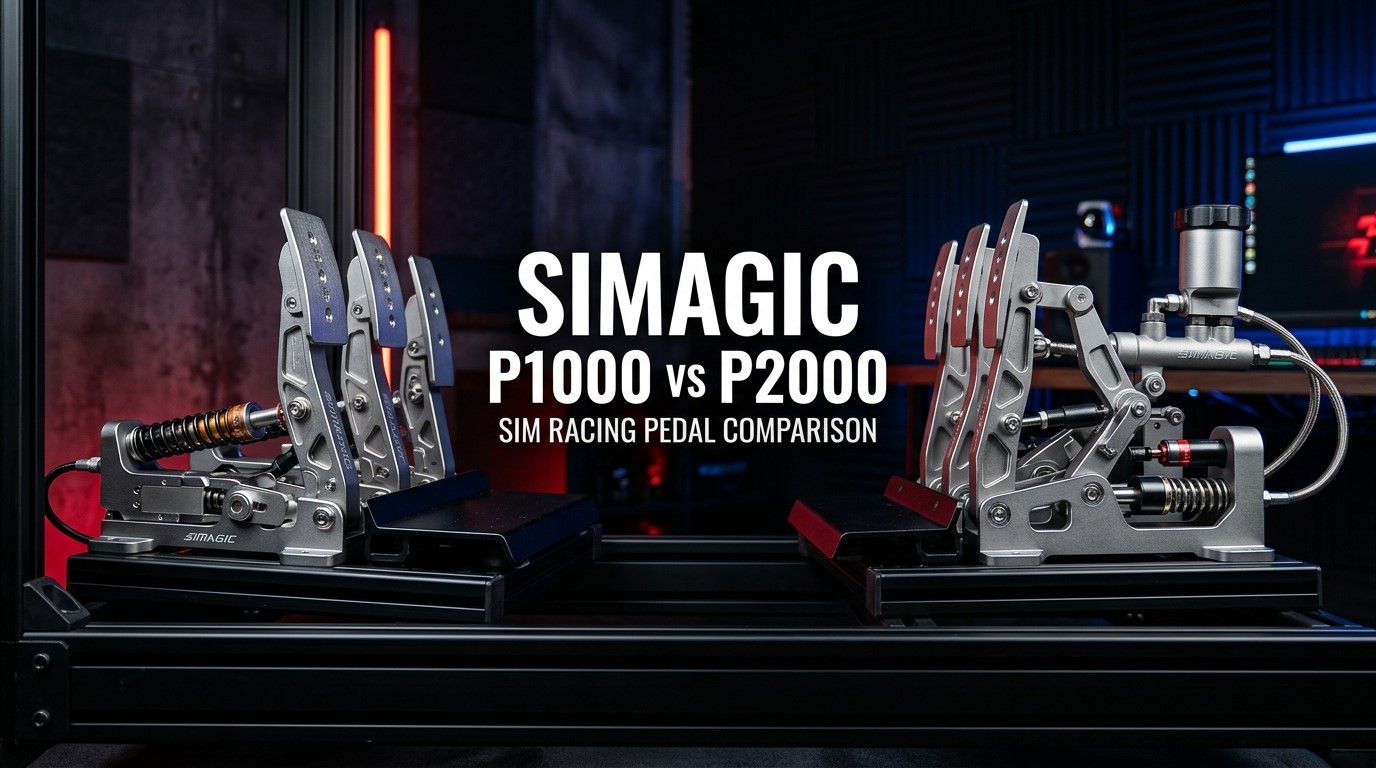
Choosing the right pedals can make a significant difference in sim racing, especially when you want consistent braking, better control through corners, and a more realistic driving experience. In the Simagic P1000 vs P2000 comparison, both pedal sets target serious sim racers, but they approach performance differently. The P1000 focuses on modularity, extensive adjustability, and upgrade flexibility, while the P2000 is known for its hydraulic braking design and its emphasis on a more physical, motorsport-inspired pedal feel. Both are designed for enthusiasts who want to move beyond basic entry-level pedals and develop more consistent driving habits.
However, the best choice depends on more than the product name or price. Your cockpit, preferred racing disciplines, braking technique, maintenance expectations, and future upgrade plans all matter. Some drivers will benefit more from the P1000’s adaptable platform, while others may prefer the P2000’s hydraulic-focused experience. In this guide, we’ll compare their key features, strengths, limitations, and practical value to help you choose the right pedals for your sim racing setup.
Feature-by-Feature Comparison
The biggest difference between these pedal sets is their design philosophy. The P1000 is a modular platform that lets you customize and expand your setup, whereas the P2000 emphasizes a hydraulic braking experience. The exact features can vary by version, so it’s important to compare the configurations you’re actually considering.
| Feature | Simagic P1000 | Simagic P2000 |
|---|---|---|
| Product category | Modular performance pedals | Hydraulic-focused performance pedals |
| Brake system | Load cell; hydraulic upgrade available on compatible versions | Hydraulic braking system |
| Brake feel | Adjustable, with mechanical or optional hydraulic configurations | More hydraulic and progressive in character |
| Load cell | 100 kg rated sensor | Sensor specifications depend on the version; check the exact model |
| Resolution | 12-bit / 4,096 levels | 12-bit / 4,096 levels reported for the range |
| Throttle | Hall-effect position sensor | Hall-effect position sensing on relevant configurations |
| Clutch | Available on three-pedal versions | Available on three-pedal versions |
| Adjustability | Extensive mechanical and software adjustments | Mechanical adjustment, with spring and hydraulic tuning options |
| Haptic feedback | Optional P-HPR pedal reactors | Do not assume P1000 accessories are compatible |
| Upgrade potential | Strong modular upgrade ecosystem | More focused on its hydraulic pedal architecture |
| Construction | CNC-machined aluminum alloy | Metal construction; confirm the materials for the specific version |
| Software | SimPro Manager | Simagic software support; verify exact model compatibility |
| Best suited for | Drivers who want flexibility and future upgrades | Drivers who prioritize hydraulic brake feel |
| Main consideration | Optional upgrades can increase the total cost | Hydraulic components add complexity and potential maintenance |
SIMAGIC’s official P1000 specifications confirm its 100 kg load-cell rating, 12-bit resolution, adjustable travel, and optional hydraulic cylinder and haptic reactor.
The P2000’s exact specifications should be checked against the particular kit being sold, especially if it is a used or older configuration.
1. Braking Performance
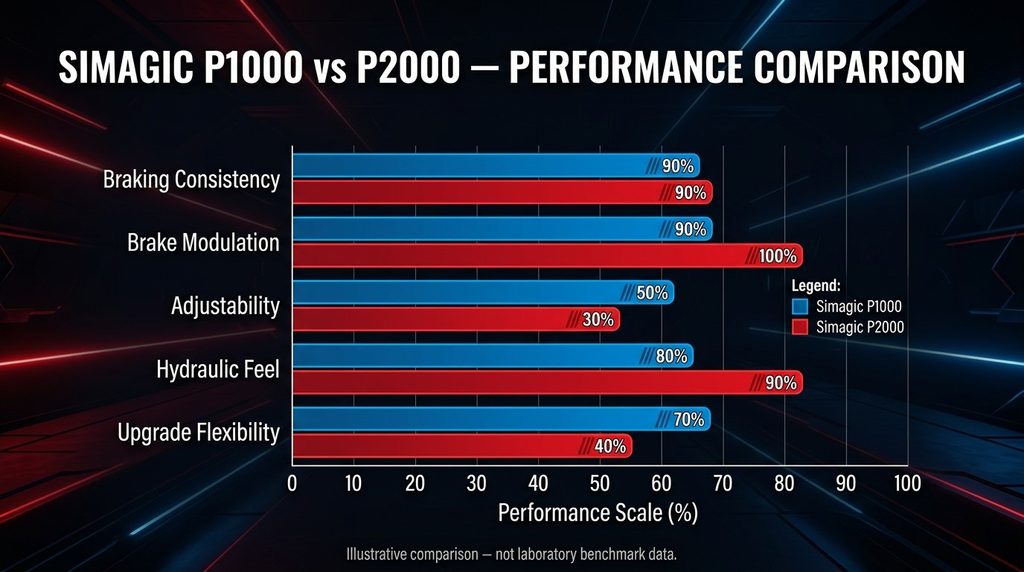
Braking is the most important consideration in this comparison because it influences consistency, confidence, and how accurately you can control the car near the limit.
The P1000 uses a load-cell-based braking approach in its standard configuration. Instead of relying exclusively on how far you push the brake pedal, it measures applied force. This allows you to develop muscle memory around braking pressure and repeat similar inputs from lap to lap.
The P2000 takes a more explicitly hydraulic approach. Its hydraulic circuit is intended to create a more physical braking sensation, with resistance and progression that can feel closer to a performance-car braking system.
Neither design automatically makes a driver faster. A well-calibrated load-cell pedal can produce excellent results, while a hydraulic pedal can feel unfamiliar until you adjust its resistance and travel to your preference.
Winner: P2000 for a hydraulic-focused experience; P1000 for flexibility and adjustability.
2. Brake Feel and Progression
Pedal feel is highly personal. Some drivers prefer a firm brake with limited movement, while others want a more progressive response that gives them room to modulate pressure.
The P1000 provides different ways to tune the brake, depending on its configuration. You can adjust the pedal’s physical characteristics and software response to find a balance between stiffness, travel, and control. For drivers who enjoy experimenting with settings, this flexibility is a major advantage.
The P2000 is attractive to drivers who specifically want hydraulic feedback. The interaction between its mechanical components and hydraulic system can deliver a distinctive resistance profile that differs from a conventional spring-and-elastomer setup.
However, hydraulic does not automatically mean more accurate. Your preferred brake feel, cockpit rigidity, and calibration all affect the final result.
Winner: P2000 for drivers who specifically want hydraulic pedal characteristics; P1000 for drivers who want a highly configurable starting point.
3. Adjustability and Customization
The P1000 is particularly appealing if you enjoy building a sim racing setup around your own preferences. Its pedal positions, travel, force characteristics, dead zones, and output curves can be adjusted to suit different driving styles.
For example, a driver who races GT3 cars might prefer a firm brake with a relatively short working range. Someone who spends more time in road cars might want additional pedal travel and a less aggressive resistance curve.
The P2000 also offers mechanical tuning, including different spring options on applicable configurations. Its hydraulic system gives you another aspect of brake feel to consider, but the adjustment process may be more involved than simply changing a spring or software setting.
If you regularly change your driving position or experiment with pedal characteristics, the P1000’s modular approach is appealing. If you find a hydraulic configuration you like and want to stick with it, the P2000 may be a better fit.
Winner: P1000 for overall modular customization.
4. Hydraulic Technology
Hydraulic technology is one of the most important distinctions when comparing the P1000 and P2000.
The P2000’s hydraulic braking system is central to its identity. It is designed for drivers seeking a more physical brake response rather than simply upgrading to a conventional load-cell pedal.
The P1000 starts from a different position. Its standard configuration offers load-cell braking, while compatible versions and optional hydraulic hardware allow you to expand the system. This gives you the choice of starting with a simpler configuration and upgrading later.
There is a practical trade-off. A hydraulic setup may involve additional components, installation considerations, and maintenance. A load-cell-based P1000 configuration can be simpler to set up and live with.
Remember that hydraulic pedals are not necessarily connected to the game’s brake-pressure system in the same way as a real car. They are simulator input devices designed to reproduce a chosen feel while sending control signals to the game.
Winner: P2000 for a hydraulic-first design; P1000 for the option to add hydraulic functionality later.
5. Build Quality and Durability
Both products are intended for serious sim racing rather than casual desktop gaming. The P1000 uses CNC-machined aluminum alloy components, which provide a rigid foundation for repeated pedal inputs.
That rigidity matters because a brake pedal can require substantial force. If the pedal assembly flexes or the cockpit moves, the driver may struggle to reproduce the same braking input consistently.
The P2000 is also designed around performance-oriented pedal hardware, but buyers should evaluate the exact revision and kit rather than assuming every package has identical construction.
Durability also depends on how the pedals are installed and maintained. Loose mounting bolts, dust, worn moving components, and neglected hydraulic connections can affect the experience over time.
For either set, use a rigid pedal plate, secure all mounting points, and periodically inspect the components that move or carry load.
Winner: No universal winner. Both are performance-oriented options, and the exact version, installation, and maintenance matter.
6. Haptic Feedback and Immersion
Haptic feedback can add another layer of information to sim racing. A pedal reactor can provide tactile signals associated with braking, wheel lockup, or other supported telemetry effects, depending on the game, software, and configuration.
The P1000 supports optional P-HPR haptic pedal reactors. These are an important part of its modular upgrade path, allowing drivers to expand the experience beyond pedal resistance alone.
With a compatible configuration, tactile feedback can help you interpret what’s happening without relying exclusively on visual indicators. The usefulness depends on how well the effects are configured and how consistently the simulator provides relevant telemetry.
The P2000’s principal appeal is its hydraulic braking character rather than the P1000’s specific modular haptic upgrade path. Do not assume that P1000 accessories will fit or operate with P2000 pedals without checking compatibility.
Winner: P1000 for its documented, modular haptic upgrade path.
7. Software and Calibration
Hardware is only part of the equation. Calibration determines how the simulator interprets your inputs, and poor settings can undermine even an expensive pedal set.
The P1000 works with SimPro Manager, which provides options for adjusting parameters such as dead zones, output curves, and pedal response. It also supports integration with SimHub for compatible features.
This allows you to refine the relationship between the physical pedal movement or pressure and the signal received by the game. Correct calibration is particularly important when you change springs, pedal travel, or other mechanical settings.
For the P2000, verify the supported software, firmware, and connection method for your exact version. Do not assume that every function or accessory supported by the P1000 will behave identically on the P2000.
Regardless of your choice, calibrate the pedals after installation, set the minimum and maximum input ranges correctly, and test the result in a familiar car before making further changes.
Winner: P1000 for its clearly documented adjustment and upgrade ecosystem.
8. Installation and Maintenance
Installation can be a major factor for sim racers with compact cockpits or limited space.
The P1000’s modular design gives you different configurations to consider, including standard and inverted variants. The official specifications list a standard footprint of approximately 334.8 × 336 × 267 mm for relevant configurations, although dimensions differ by version.
The P2000’s hydraulic hardware deserves additional attention during installation. Make sure the pedal assembly fits your mounting plate, the hydraulic components have adequate clearance, and the setup can be accessed for inspection when needed.
A hydraulic system is not inherently unreliable, but it introduces components that need to be kept in good condition. Before purchasing, ask about servicing, replacement parts, and the availability of support in your region.
Winner: P1000 for a simpler standard configuration; the advantage depends on whether you purchase hydraulic upgrades.
Quick Highlights Table
If you want the main differences at a glance, this table summarizes the practical advantages of each pedal set.
| Category | Better Choice | Why |
|---|---|---|
| Standard load-cell setup | P1000 | Offers a strong performance foundation |
| Hydraulic braking | P2000 | Hydraulic braking is central to its design |
| Upgrade flexibility | P1000 | Modular options let you expand over time |
| Haptic pedal upgrades | P1000 | Supports optional P-HPR reactors |
| Software adjustment | P1000 | Documented SimPro Manager adjustment options |
| Compact standard configuration | P1000 | Its standard configuration has a documented compact footprint |
| Physical hydraulic feel | P2000 | Appeals to drivers who prefer hydraulic resistance |
| Long-term customization | P1000 | Supports a range of compatible upgrades |
| Simplified ownership | P1000 standard | Avoids additional hydraulic hardware |
| Best for hydraulic enthusiasts | P2000 | Focuses on a hydraulic braking experience |
These are practical recommendations rather than laboratory performance rankings. Your results will depend on the exact product configuration, installation, calibration, and personal preference.
Key Takeaways
The Simagic P1000 and P2000 both target sim racers who want more control than basic pedal sets can offer. The important question is whether you prefer a configurable platform or a hydraulic-focused experience.
- Choose the P1000 if you want extensive adjustability and the ability to upgrade gradually.
- Choose the P2000 if hydraulic braking feel is your main priority.
- Consider your cockpit before purchasing either set, especially if you use a compact rig or need inverted pedals.
- Do not judge performance by the sensor rating alone. Calibration, mounting rigidity, and your braking technique matter considerably.
- Plan your total budget. Optional hydraulic components, haptic reactors, mounting hardware, and accessories can increase the final cost of a P1000 setup.
- Check the exact version. Pedal count, hydraulic equipment, and included accessories can differ between packages.
For most drivers who value flexibility, the P1000 is the more adaptable choice. The P2000 is worth considering when its hydraulic character matches your preferred driving experience.
Pros & Cons of Simagic P1000 and P2000
Understanding the advantages and limitations of both products makes it easier to decide which one deserves a place in your cockpit. In the Simagic P1000 vs P2000 comparison, neither pedal set is ideal for every driver.
Simagic P1000 Pros & Cons
Pros
- Highly adjustable pedal positioning and response.
- 100 kg-rated load cell in the documented configurations.
- Strong modular upgrade potential.
- Optional P-HPR haptic pedal reactors.
- Optional hydraulic hardware on compatible versions.
- SimPro Manager support for calibration and input tuning.
- CNC-machined aluminum alloy construction.
- Available in configurations suited to different cockpit arrangements.
Cons
- Optional upgrades can make the complete setup considerably more expensive.
- Finding your preferred settings may require experimentation.
- The standard configuration does not provide the same hydraulic hardware as a fully equipped hydraulic version.
- Some accessories require additional purchases.
- Incorrect calibration can reduce consistency despite the capable hardware.
Simagic P2000 Pros & Cons
Pros
- Hydraulic-focused braking experience.
- Appeals to drivers seeking a more physical brake response.
- Offers mechanical tuning options on applicable configurations.
- Available in configurations intended for performance-oriented sim racing.
- A compelling alternative for drivers who already know they prefer hydraulic pedals.
Cons
- Hydraulic components can introduce additional maintenance requirements.
- The setup may be more involved than a conventional load-cell configuration.
- Compatibility and included accessories need to be checked carefully.
- Less attractive if you want to build a system around the P1000’s specific modular upgrades.
- The hydraulic feel may not suit every driver.
- The value depends heavily on the price and configuration available in your market.
Buying Recommendations
The best pedal set depends on the type of racing you enjoy, how much you want to customize your equipment, and how much you’re willing to spend.
Best for Beginners Upgrading to Serious Sim Racing: Simagic P1000
The P1000 is a strong option for someone moving from entry-level pedals to a more adjustable setup. You can begin with the standard configuration, develop your braking technique, and decide later whether hydraulic hardware or haptic feedback would improve your experience.
You don’t need every available accessory to benefit from a good load-cell brake. Consistent pressure application, a stable cockpit, and appropriate calibration are more important than purchasing every upgrade immediately.
Best for GT3 and Competitive Circuit Racing: Simagic P1000
GT3 and other circuit-racing disciplines reward repeatable braking, precise trail braking, and consistency across long stints. The P1000’s adjustment options can help you establish a brake feel that suits your preferred car and driving style.
For competitive racing, start with a stable, firm brake configuration and calibrate the input range carefully. Spend time practicing the same braking points before changing your settings.
The P2000 can also suit GT3 racing, particularly if you prefer hydraulic feedback. The deciding factor should be your preferred feel, not the assumption that one mechanism automatically produces faster lap times.
Best for Hydraulic Pedal Enthusiasts: Simagic P2000
If you’ve already tried hydraulic sim racing pedals and know you enjoy their resistance characteristics, the P2000 deserves serious consideration.
Its main attraction is the hydraulic-focused design. Rather than purchasing a standard set and planning several upgrades, you can concentrate on finding a suitable hydraulic configuration from the outset.
Before buying, compare the package contents and make sure you understand any maintenance requirements. Also check whether the product is new, used, or an older revision.
Best for Gradual Upgrades: Simagic P1000
The P1000 makes sense for sim racers who prefer to improve their setup one component at a time.
You might begin with the standard pedals, refine your calibration, and later consider haptic reactors or compatible hydraulic hardware. This approach lets you evaluate each upgrade instead of spending heavily before knowing what you need.
The important qualification is that optional accessories are not free. Compare the price of your intended fully equipped P1000 against the price of the P2000 package before making a decision.
Best for a More Immersive Setup: Simagic P1000
For drivers interested in combining brake feel with tactile feedback, the P1000’s optional haptic reactors provide an attractive upgrade route.
Haptics are most useful when the effects are configured appropriately and communicate meaningful information. They won’t automatically make you faster, but they can add another layer of feedback to your simulator.
If hydraulic brake feel is more important to you than haptics, the P2000 may still be the better fit.
Best for Budget-Conscious Buyers: Depends on the Package
There isn’t a universal winner for value because retail prices vary by region, configuration, shipping, and included accessories.
Compare the total price of the exact pedal set you want. Include any hydraulic upgrades, haptic hardware, mounting brackets, and other necessary accessories. If you’re buying from a local retailer, also consider warranty coverage and replacement-part availability.
For many buyers, a standard P1000 configuration will be more sensible than an expensive package filled with features they may never use. For someone who specifically wants hydraulic braking, a well-priced P2000 package could offer better value.
Final Verdict
The Simagic P1000 is the better all-round choice for most sim racers who value flexibility, while the Simagic P2000 is the more targeted choice for drivers who prioritize hydraulic braking feel.
The P1000 offers a versatile combination of load-cell braking, extensive adjustment options, software calibration, and a modular upgrade path. It is particularly appealing if you’re still discovering your ideal pedal setup or expect your rig to evolve over time.
The P2000 has a clearer appeal for drivers who already know they want a hydraulic-focused braking experience. Its design makes it worth considering for enthusiasts who prioritize the physical characteristics of the brake above modularity.
Neither set guarantees faster lap times. The most important factors remain consistent technique, appropriate calibration, and a rigid installation.
My recommendation is to start with the P1000 if you want flexibility and a system you can expand gradually. Choose the P2000 if hydraulic pedal feel is your main objective and its specific configuration suits your cockpit and budget.
FAQs about Simagic P1000 and P2000
Q1: What is the main difference between Simagic P1000 and P2000?
Ans: The main difference is their design philosophy. The P1000 is a modular pedal set with load-cell braking and optional upgrades, including hydraulic hardware on compatible versions. The P2000 focuses on hydraulic braking. The better option depends on whether you value customization or a hydraulic-focused experience.
Q2: Is the Simagic P1000 better than the P2000?
Ans: The P1000 is generally the more versatile option for drivers who want extensive adjustments and future upgrades. The P2000 may be preferable if you specifically want hydraulic braking characteristics. Neither is universally better, because pedal feel and setup preferences differ between drivers.
Q3: Does the Simagic P1000 have a load cell?
Ans: Yes. SIMAGIC lists a 100 kg-rated load-cell sensor for the P1000 range. The standard braking configuration uses load-cell technology, although exact hardware arrangements vary by model. A load cell measures applied force, allowing you to develop consistent braking pressure rather than relying exclusively on pedal travel.
Q4: Is the Simagic P2000 a hydraulic pedal set?
Ans: The P2000 is known for its hydraulic braking design. It is intended for sim racers seeking a more physical, hydraulic-focused brake response. Before purchasing, confirm the exact model, included components, and specifications with the seller, especially if you’re considering a used unit or an older package.
Q5: Can you upgrade the Simagic P1000 with hydraulic braking?
Ans: Yes. SIMAGIC offers hydraulic cylinder hardware for compatible P1000 configurations. However, compatibility and included equipment depend on the specific version. Check the official product information before purchasing an upgrade, and compare the complete cost against a P2000 package.
Q6: Which is better for competitive sim racing, P1000 or P2000?
Ans: Both can be suitable for competitive sim racing. The P1000 offers extensive adjustability, while the P2000 appeals to drivers who prefer hydraulic braking. Consistent calibration, a rigid cockpit, and repeatable braking technique have a major influence on performance. Neither pedal set automatically produces faster lap times.
Q7: Is the Simagic P1000 worth buying in 2026?
Ans: The P1000 is worth considering in 2026 if you want a configurable performance pedal set with a documented upgrade ecosystem. Its value depends on current local pricing, the version you purchase, and the accessories you need. Compare the complete cost with the P2000 before deciding, and check warranty and replacement-part availability in your region.
Short Conclusion
The Simagic P1000 vs P2000 decision comes down to flexibility versus hydraulic-focused braking. The P1000 is the more adaptable choice for sim racers who want to customize their pedals and upgrade over time. The P2000 is worth considering if you specifically prefer hydraulic brake feel. Choose the set that matches your driving style, cockpit, and total budget rather than buying based on specifications alone.