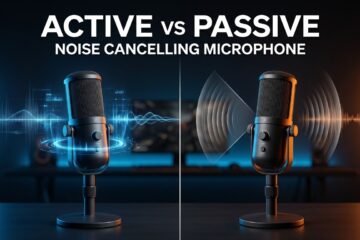
When shopping for headphones, you will often see terms such as ANC and PNC, but these technologies handle outside noise in very different ways. ANC, or Active Noise Cancellation, uses microphones, processing hardware, and specially generated anti-noise to reduce unwanted sounds. PNC, or Passive Noise Cancellation, more accurately called passive noise isolation, relies on physical barriers such as ear cups, padding, and ear tips to reduce the amount of outside sound reaching your ears.
Understanding ANC vs PNC headphones is important because neither technology works exactly the same way across every environment. ANC is particularly useful for steady, low-frequency sounds such as airplane engines, air conditioners, and road or train rumble. PNC depends heavily on the physical fit and can be particularly useful for reducing higher-frequency sounds and sudden environmental noise.
In this guide, we’ll compare ANC and PNC across noise reduction, sound quality, comfort, battery life, cost, travel, office use, gaming, and everyday listening. We’ll also explain why many modern headphones combine both technologies instead of choosing only one.
Feature-by-Feature Comparison Table
Before looking at individual differences, this table provides a quick overview of how ANC and PNC headphones compare.
| Feature | ANC Headphones | PNC Headphones |
| Full Name | Active Noise Cancellation | Passive Noise Cancellation / Isolation |
| Main Technology | Electronic noise cancellation | Physical noise blocking |
| How It Works | Microphones detect noise and electronics generate opposing sound | Ear cups, cushions, or ear tips physically block sound |
| Battery Required | Yes for ANC operation | No |
| Low-Frequency Noise | Excellent in many designs | Generally limited |
| High-Frequency Noise | Can be less effective | Often effective with a good seal |
| Engine Rumble | Very effective | Moderate depending on design |
| Voices | Reduces them, but may not eliminate them | Physical isolation can reduce them |
| Keyboard/Clicks | Limited to moderate | Often useful |
| Sudden Sounds | Limited | Physical isolation works continuously |
| Comfort | Depends on headphone design and ANC implementation | Depends mainly on fit, clamping force, and padding |
| Sound Processing | Yes when ANC is active | No electronic cancellation |
| Battery Life | ANC can reduce battery runtime | No battery impact |
| Price | Often more expensive | Often cheaper |
| Maintenance | More electronics to manage | Simpler design |
| Best For | Travel, commuting, steady background noise | Simple isolation, offices, music listening |
| Works When Powered Off | Depends on model; passive isolation may remain | Yes |
| Transparency Mode | Common on modern ANC models | Not normally available |
| Adaptability | Can adjust to changing noise | Depends on physical fit |
| Best Overall Approach | ANC + good passive isolation | Strong passive isolation |
The most important point is that ANC and PNC are not competing versions of exactly the same technology. ANC electronically reduces detected sound, while PNC physically reduces how much sound reaches your ears. Modern ANC headphones generally use passive isolation as well, so the two approaches often work together.
Quick Highlights Table
If you only have a few seconds to understand the difference, these are the key points to remember.
| Category | ANC | PNC |
| Best at | Continuous background noise | Physical sound isolation |
| Biggest advantage | Reduces low-frequency environmental noise | Requires no electronics |
| Biggest limitation | Requires power and may struggle with some sudden/high-frequency sounds | Depends heavily on fit and seal |
| Battery | Required for active cancellation | Not required |
| Travel | Excellent for engine/road/train rumble | Useful but less effective against deep rumble |
| Office | Good for HVAC and general background noise | Good for voices and physical isolation |
| Music | Lets you listen at lower volume in noisy environments | Can provide natural isolation |
| Gaming | Useful for external environmental noise | Useful for physical isolation |
| Cost | Usually higher | Usually lower |
| Flexibility | Multiple listening modes may be available | Simple and consistent |
| Ideal Buyer | Frequent traveler or commuter | User who wants simple, battery-free isolation |
Key Takeaways
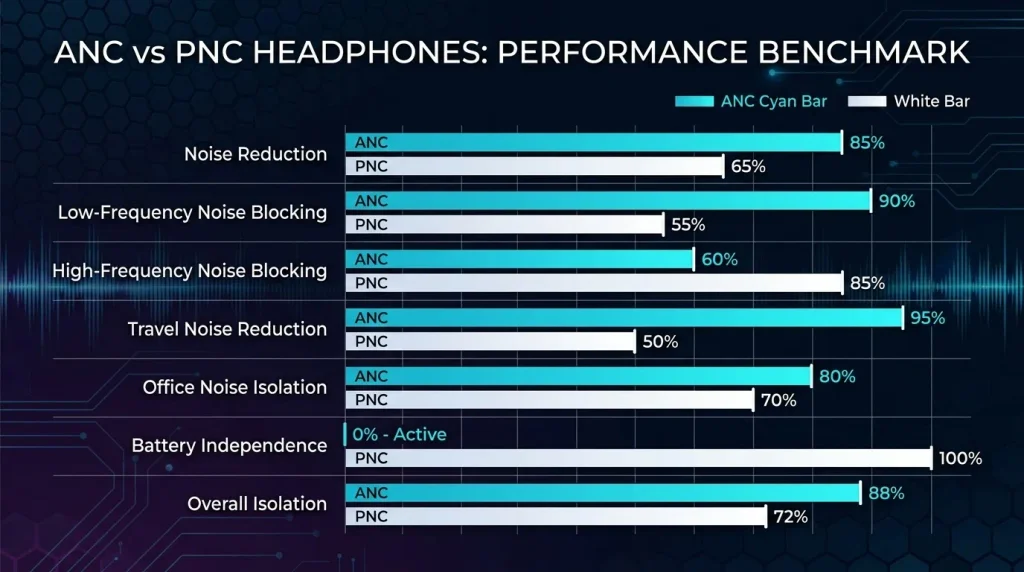
The biggest lesson from the ANC vs PNC headphones comparison is that these technologies solve noise problems differently.
- ANC uses microphones and electronics to detect surrounding noise and generate an opposing signal.
- PNC uses physical construction to reduce the amount of external sound entering your ears.
- ANC generally has an advantage against steady, low-frequency sounds, such as airplane engines and air-conditioning hum.
- PNC can be valuable for mid- and high-frequency sounds, particularly when headphones create a strong seal around the ears.
- ANC requires a power source, while PNC works without batteries.
- A well-designed ANC headphone normally combines active cancellation with passive isolation rather than relying entirely on ANC.
- Comfort and fit can significantly affect passive isolation.
- ANC does not make headphones completely silent. Its effectiveness varies according to the headphone design, microphones, processing, fit, and type of environmental noise.
- PNC continues working even when there is no active electronic processing.
- For many users, the most useful combination is good passive isolation plus effective ANC.
What Is ANC?
ANC stands for Active Noise Cancellation. Instead of simply putting a physical barrier between your ears and the outside world, ANC uses microphones and electronic processing to identify environmental sound.
The microphones monitor surrounding noise, and the headphone’s processing system creates an opposing signal designed to reduce that unwanted sound through destructive interference.
Imagine sitting next to an airplane engine. The engine produces a continuous low-frequency rumble. ANC headphones can monitor that sound and generate an opposing acoustic signal. When the original sound and anti-noise interact, the perceived level of the unwanted noise can be reduced.
This makes ANC particularly useful for predictable and continuous sounds.
Common examples include:
- Airplane engine noise
- Bus and train rumble
- Road noise
- Air-conditioning systems
- Fans
- Office HVAC systems
- Continuous machinery
- General low-frequency environmental noise
However, ANC is not equally effective against every sound. High-frequency and sudden noises can be more challenging because the system has less time and acoustic opportunity to counter them. This is one reason passive isolation remains important.
How ANC Works
A typical ANC system can involve microphones positioned outside and/or inside the headphone enclosure. These microphones monitor environmental sound, while a processor analyzes the signal and produces anti-noise.
Different ANC implementations use different microphone arrangements. Feedforward systems use external microphones, while feedback systems use microphones closer to the ear. Some headphones combine multiple approaches.
The quality of ANC therefore depends on more than simply having an “ANC” label.
Microphone placement, processing, software, acoustic design, ear-pad seal, and tuning can all influence the final experience.
What Is PNC?
PNC stands for Passive Noise Cancellation, although passive noise isolation is often a more technically accurate description.
Unlike ANC, PNC does not electronically cancel environmental sound. Instead, the headphone physically prevents some external sound from reaching your ears.
Think about putting your hands over your ears. Outside sounds become quieter because you have created a physical barrier.
Headphones achieve the same basic principle using materials and design.
For over-ear headphones, passive isolation can come from:
- Thick ear cushions
- Closed-back ear cups
- Dense padding
- A secure seal around the ears
- Proper headband pressure
- Cup shape and materials
For earbuds, passive isolation primarily comes from:
- Silicone ear tips
- Foam ear tips
- Proper ear-canal fit
- The shape of the earbud
- A good seal inside the ear
The better the physical seal, the less external sound can reach the ear directly.
ANC vs PNC: How Noise Reduction Differs
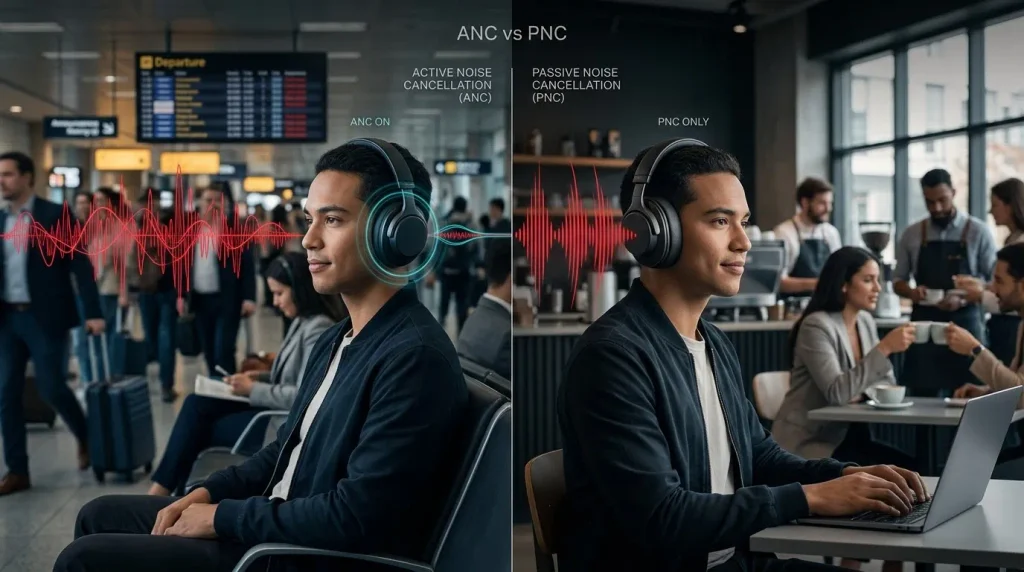
The most important difference between ANC and PNC is how they attack unwanted sound.
PNC creates a physical barrier. ANC uses electronic processing to reduce detected environmental noise.
This distinction matters because sound contains different frequencies and behaves differently depending on its source.
ANC is particularly useful against steady low-frequency sounds. PNC, meanwhile, can help reduce a wider range of sound simply by physically blocking it, although its effectiveness depends heavily on the design and fit.
For example, imagine you’re sitting on a train.
The low rumble from the tracks can be difficult to block completely with physical materials alone. ANC can specifically target that continuous low-frequency component.
At the same time, the physical ear cups can help reduce higher-frequency sounds such as conversations, tapping, and other environmental noises.
That’s why combining the two approaches can be so effective.
ANC vs PNC for Sound Quality
Sound quality is another important part of the comparison.
PNC itself doesn’t require an electronic anti-noise signal. Because of this, there is no ANC processing layer affecting the sound reproduction.
ANC headphones, however, actively process environmental sound while playing your music. Some implementations can introduce small changes in tonal balance or other audible characteristics when ANC modes are switched. The effect varies considerably from one headphone design to another.
That doesn’t mean PNC headphones automatically sound better.
A high-quality ANC headphone can sound substantially better than an inexpensive passive-isolation headphone because sound quality depends on many other components, including:
- Driver quality
- Tuning
- Amplification
- Digital signal processing
- Frequency response
- Distortion
- Ear-pad design
- Codec support
- Software
The important point is that ANC should not be confused with sound quality itself.
ANC primarily affects environmental noise. The actual quality of your music depends on the complete headphone system.
ANC vs PNC for Travel
Travel is one of the clearest use cases for ANC.
Airplanes, trains, buses, and cars generate significant amounts of continuous background noise. Much of that noise contains low-frequency energy, which is exactly where ANC can be particularly useful.
PNC still helps because the ear cups physically block sound, but ANC can provide another layer of reduction.
For frequent travelers, this combination can make listening more comfortable because you don’t have to compete with the surrounding environment as much.
Another benefit is that reducing external noise may allow you to listen at a more comfortable volume rather than continually increasing volume to overcome background noise.
For occasional travel, however, a well-sealing passive headphone can still be useful if you don’t need the additional electronic features of ANC.
ANC vs PNC for Office and Study
The office environment presents a different challenge.
You may encounter:
- Conversations
- Keyboard sounds
- Phone notifications
- Air conditioning
- Printers
- Footsteps
- Background chatter
ANC can be very useful for steady HVAC noise and general low-frequency background sound. But passive isolation also plays an important role when dealing with voices and higher-frequency environmental sounds.
For studying, either approach can work depending on your environment.
If your room has an air conditioner or fan constantly running, ANC may be especially helpful.
If you’re primarily trying to reduce nearby voices and physical sounds, a strong seal from closed-back headphones or well-fitting earbuds may contribute significantly to isolation.
For the best overall result, headphones combining both approaches can offer broader noise reduction.
ANC vs PNC for Gaming
Gaming introduces additional considerations.
If you’re gaming in a noisy environment, ANC can reduce background distractions. This can be useful when you’re trying to concentrate on a game or communicate with teammates.
However, competitive gamers may care more about:
- Positional audio
- Imaging
- Microphone quality
- Latency
- Comfort
- Soundstage
- Game-specific tuning
ANC itself doesn’t guarantee better gaming audio.
For a quiet gaming room, passive isolation may already be sufficient. In a noisy room, ANC can provide an additional layer of environmental noise reduction.
If you’re using a wired gaming headset, passive isolation can also be useful because it doesn’t depend on battery power.
ANC vs PNC for Battery Life
This is one area where PNC has an obvious advantage.
Passive isolation does not require electronics to block outside sound. There is therefore no battery requirement for the isolation itself.
ANC, on the other hand, requires microphones, processing, and electronic circuitry. Wireless ANC headphones consequently use battery power when active cancellation is enabled.
Battery performance varies significantly between models.
Some headphones offer multiple listening modes, allowing you to disable ANC when it isn’t necessary. This can help extend battery life.
For example, you may use ANC while traveling but turn it off when sitting in a quiet room.
This flexibility is one of the practical advantages of modern ANC headphones.
ANC vs PNC for Comfort
Comfort is more complicated than simply choosing ANC or PNC.
PNC depends heavily on physical fit. Over-ear headphones need cushions that create a seal without producing excessive clamping pressure.
If the fit is too loose, external sound can enter around the ear cups.
If the fit is too tight, you may experience discomfort during long listening sessions.
ANC introduces another potential consideration. Some people notice a sensation associated with strong active cancellation, sometimes described as pressure or an unusual feeling in the ears. This isn’t universal and depends on the listener and headphone design.
Comfort therefore depends on:
- Ear-pad material
- Headband design
- Weight
- Clamping force
- Ear-cup size
- Earbud shape
- ANC implementation
- Personal sensitivity
- Listening duration
A technically impressive headphone isn’t necessarily the most comfortable headphone for every person.
ANC vs PNC for Cost
PNC headphones can be less expensive because they don’t need the microphones, processors, ANC circuitry, and related electronics required for active cancellation.
ANC headphones typically include additional hardware and software, although ANC is now available across a much wider range of prices than it was in the past.
Current headphone markets include affordable ANC models as well as premium products with sophisticated adaptive cancellation, multiple microphones, transparency modes, and advanced processing.
If your primary requirement is simply blocking some environmental noise, PNC may provide enough value.
If you frequently travel or work in noisy environments, ANC can justify the additional cost because it adds an electronic layer of noise reduction.
Why the Best Headphones Often Use Both
The ANC vs PNC comparison can make it sound like you have to choose one technology.
In practice, you often don’t.
Many modern ANC headphones combine active cancellation and passive isolation.
The physical design handles part of the noise reduction while ANC targets environmental noise electronically. Bose, for example, describes noise-cancelling headphones as combining passive isolation from the physical design with active cancellation from microphones and digital processing.
This combination makes sense because the two systems have different strengths.
A sealed ear cup can physically block some high-frequency sound while ANC works on continuous low-frequency noise.
The result is a more comprehensive approach than relying entirely on one technology.
Pros & Cons
When comparing ANC vs PNC headphones, each technology has advantages and limitations. The right choice depends on the environment, listening habits, budget, and whether you value battery-powered features.
ANC Headphones — Pros
- Excellent for continuous background noise
- Particularly useful for low-frequency rumble
- Great for airplanes and public transportation
- Useful in offices and busy environments
- Often includes transparency or ambient modes
- Can provide a quieter environment for music and podcasts
- Works together with passive isolation in many modern designs
- More adaptable to changing environments
ANC Headphones — Cons
- Requires battery power for active cancellation
- Usually costs more than basic passive headphones
- Can sometimes affect the perceived sound depending on implementation
- May not eliminate voices and sudden sounds completely
- Wind can create challenges for some ANC systems
- Some listeners may notice an unusual pressure sensation
PNC Headphones — Pros
- Doesn’t require battery power for isolation
- Simple and reliable
- Can be highly effective with a good physical seal
- Useful against many mid- and high-frequency sounds
- Often more affordable
- No ANC processing is required
- Continues providing isolation when electronic features are unavailable
PNC Headphones — Cons
- Effectiveness depends heavily on fit
- Deep low-frequency rumble can be difficult to block
- No electronic noise-cancellation adjustment
- No active transparency mode
- Tight seals can sometimes become uncomfortable
- Passive isolation varies substantially between headphone designs
Buying Recommendations
Choosing between ANC and PNC becomes easier when you start with your actual listening environment.
Choose ANC If You Travel Frequently
If you’re regularly on airplanes, trains, buses, or other forms of transportation, ANC can be particularly useful.
Continuous engine and road rumble are exactly the kind of environmental noise for which active cancellation is designed.
Look for a model with effective ANC, comfortable ear pads, long battery life, and a strong passive seal.
Choose PNC If You Want Simplicity
If you don’t want to worry about charging, microphones, ANC settings, or battery life, passive isolation is straightforward.
A well-designed closed-back headphone or properly fitting earbud can reduce outside noise without requiring active electronics.
Choose ANC + Strong Passive Isolation for Mixed Environments
For people who move between airplanes, offices, cafés, homes, and public transportation, a headphone combining both technologies offers the broadest approach.
This is generally how modern noise-cancelling headphones are designed: physical isolation provides one layer while ANC adds another.
Choose PNC for Battery-Free Listening
If you regularly forget to charge wireless headphones, passive isolation has an important advantage.
The physical noise-blocking properties don’t disappear simply because a battery is empty.
This can be particularly useful with wired headphones.
Choose ANC for a Noisy Commute
Commuters dealing with buses, trains, traffic, or other continuous environmental sounds can benefit from ANC.
The technology can reduce the background rumble that passive isolation alone may struggle to handle.
Choose Based on Fit for Earbuds
With earbuds, fit is particularly important.
An earbud that doesn’t seal properly may provide disappointing passive isolation regardless of its specifications.
ANC cannot completely compensate for a poor fit either. The physical seal remains an important part of overall noise reduction.
Final Verdict
The ANC vs PNC headphones comparison isn’t really about declaring one technology universally superior. They work differently and have different strengths.
ANC uses microphones and electronic processing to actively reduce environmental noise, making it particularly useful for steady low-frequency sounds such as airplane engines, road rumble, and HVAC systems. PNC relies on physical construction and fit to prevent external sound from reaching your ears.
PNC is simpler, requires no battery, and can provide strong isolation when the headphone or earbud fits properly. ANC adds another layer of noise reduction and can be especially useful when your environment contains continuous background noise.
For many modern headphones, the most practical design isn’t ANC or PNC. It’s ANC plus good passive isolation.
The right choice ultimately depends on your environment, budget, comfort preferences, and how often you encounter unwanted background noise.
FAQs about ANC and PNC
Q1: What is the main difference between ANC and PNC headphones?
Ans: ANC uses microphones, electronic processing, and anti-noise to reduce external sounds. PNC, or passive noise isolation, uses the physical design of headphones or earbuds to block or reduce outside sound.
Q2: Is ANC better than PNC for airplane travel?
Ans: ANC can be particularly useful on airplanes because it is designed to reduce continuous low-frequency sounds such as engine rumble. Physical passive isolation still contributes to the overall result, especially for sounds ANC doesn’t handle as effectively.
Q3: Do PNC headphones need a battery?
Ans: No. Passive noise isolation relies on physical materials, ear cups, padding, or ear tips, so the isolation itself doesn’t require electrical power.
Q4: Does ANC completely block outside noise?
Ans: No. ANC reduces unwanted noise rather than guaranteeing complete silence. Its effectiveness depends on the headphone’s microphones, processing, acoustic design, fit, and the type of sound being produced. Sudden and high-frequency sounds can be more difficult to reduce.
Q5: Can headphones have both ANC and PNC?
Ans: Yes. In fact, many modern ANC headphones use both technologies. Passive isolation comes from the physical headphone design, while ANC provides an additional electronic layer of noise reduction.
Q6: Does ANC use more battery power?
Ans: Yes. Active noise cancellation requires microphones, processing, and electronic circuitry, so enabling ANC consumes battery power. Passive isolation itself does not require battery power.
Q7: Which is better for everyday use, ANC or PNC?
Ans: It depends on your environment. PNC can be sufficient in quieter surroundings or when you want simple battery-free isolation. ANC can be more useful when you frequently encounter continuous background noise such as transportation, fans, air conditioning, or busy public spaces. Many users may benefit from headphones that combine both.
Short Conclusion
Understanding ANC vs PNC headphones makes it easier to choose the right type of noise reduction for your lifestyle. ANC uses electronic processing to reduce surrounding noise, while PNC relies on physical isolation. ANC is particularly useful for continuous low-frequency sounds, while passive isolation remains important for broader physical sound blocking. For maximum flexibility, headphones combining effective ANC with strong passive isolation provide both technologies in one package.