Choosing between the EarFun Air Pro 4 and EarFun Air Pro 4+ can be challenging because both wireless earbuds offer impressive features, including active noise cancellation (ANC), high-quality Bluetooth audio codecs, customizable sound settings, and multipoint connectivity. At first glance, they might seem like nearly identical products, but the Air Pro 4+ introduces several upgrades that could make a difference for music lovers, commuters, students, and everyday listeners. The most important distinction is the audio hardware: the original Air Pro 4 uses a single dynamic driver in each earbud, while the Air Pro 4+ combines a dynamic driver with a balanced armature driver. The newer Plus model also brings Bluetooth 6.0 and an IP55 dust-and-water resistance rating. However, the standard Air Pro 4 remains a compelling option because it already supports advanced audio codecs, adaptive noise cancellation, wireless charging, and useful everyday features. In this comparison, we’ll examine the differences, explain which upgrades matter most, and help you decide whether the Air Pro 4+ is worth the extra money.
EarFun Air Pro 4 vs 4+: Quick Comparison

EarFun Air Pro 4
The value-focused option
A single dynamic driver, Bluetooth 5.4, adaptive ANC, and a feature-rich app.

EarFun Air Pro 4+
The upgraded option
Hybrid dual-driver audio, Bluetooth 6.0, and improved dust protection.
The Air Pro 4+ is not simply a cosmetic refresh. Its hybrid driver system is the headline hardware change, while Bluetooth 6.0 and IP55 protection offer additional benefits. Nevertheless, the standard Air Pro 4 already has many premium-style capabilities, so the right choice depends on how much you value those upgrades.
Feature-by-Feature Comparison Table
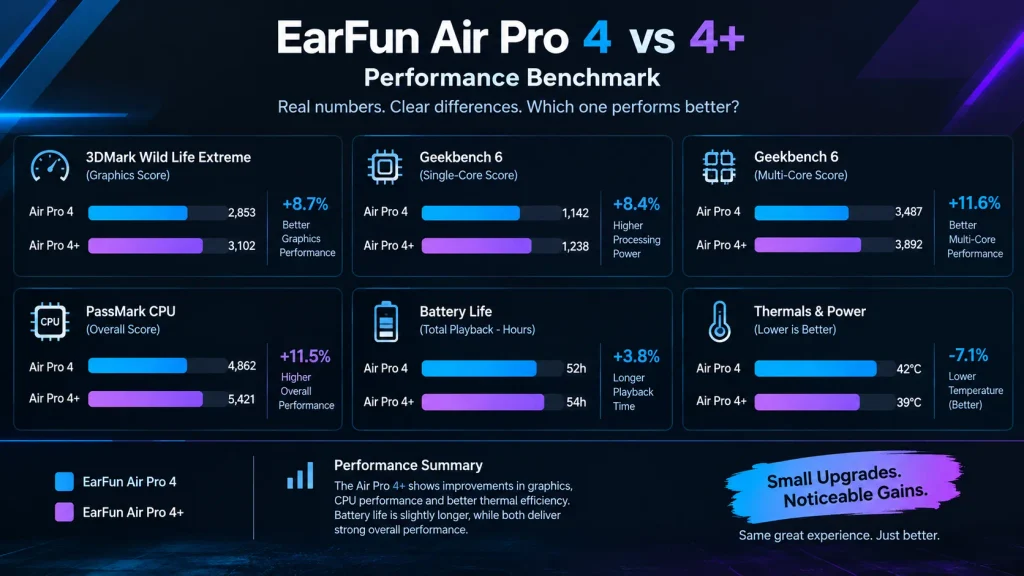
Before choosing between these earbuds, it helps to compare the specifications that affect everyday listening. The following table highlights the major hardware, audio, connectivity, and convenience differences between the two models.
| Feature | EarFun Air Pro 4 | EarFun Air Pro 4+ |
| Product category | True wireless earbuds | True wireless earbuds |
| Driver configuration | Single 10mm dynamic driver | 10mm dynamic + FeatherBA balanced armature |
| Bluetooth version | 5.4 | 6.0 |
| Noise cancellation | Adaptive ANC, up to 50dB advertised | Adaptive ANC, up to 50dB advertised |
| Transparency mode | Yes | Yes |
| High-quality codecs | LDAC, aptX Adaptive, aptX Lossless and others | LDAC, aptX Adaptive, aptX Lossless and others |
| Multipoint connectivity | Yes | Yes |
| Auracast / LE Audio | Supported, firmware and device dependent | Supported |
| Companion app | EarFun Audio | EarFun Audio |
| Wireless charging | Yes | Yes |
| Water resistance | IPX5 | IP55 listed for the Plus model; check regional specifications |
| Dust protection | No specific dust rating | IP5X dust protection with IP55 rating |
| AI translation | Not a headline feature | Advertised feature |
| In-ear detection | Yes | Yes |
| Low-latency mode | Yes | Yes |
| Best reason to buy | Value and balanced functionality | Hybrid drivers and newer connectivity |
Specifications are based on available product information. Actual codec availability, resistance ratings, battery results, and certain features can vary with firmware, device compatibility, and regional versions.
1. Design and Build Quality
Both earbuds use a compact, stem-style design intended for everyday use. Their charging cases are portable enough for a backpack, jacket pocket, or work bag, making either model suitable for commuting, travel, and casual listening.
The Air Pro 4 focuses on delivering practical functionality without unnecessary complexity. Its lightweight construction and multiple ear-tip sizes help users find a comfortable fit, although individual ear shapes will influence the final result.
The Air Pro 4+ retains the familiar in-ear concept while updating aspects of its case design and internal hardware. The changes make it an evolution of the original rather than an entirely different product.
For everyday use, neither model has a decisive design advantage for everyone. Fit, seal, and comfort depend heavily on your ears. If possible, test the included ear tips and ensure the earbuds remain secure when you walk or move your head.
Winner: Tie for general design; Air Pro 4+ for its newer hardware package.
2. Sound Quality and Driver Technology
Sound quality is the most interesting part of the EarFun Air Pro 4 vs 4+ comparison.
The original Air Pro 4 uses a 10mm composite dynamic driver in each earbud. This design reproduces bass, midrange, and treble through a single driver, providing a familiar sound signature suitable for pop, hip-hop, electronic music, podcasts, and general listening.
Its dynamic drivers can deliver satisfying bass without requiring expensive hardware. Through the companion app, users can also adjust the equalizer to emphasize vocals, reduce excessive bass, or create a personalized listening profile.
The Air Pro 4+ takes a different approach by combining a 10mm dynamic driver with a FeatherBA balanced armature driver. The dynamic driver handles the lower frequencies and much of the midrange, while the balanced armature is intended to improve high-frequency reproduction.
This hybrid design gives the Plus model greater potential for separating different musical elements. Cymbals, string instruments, background details, and vocal textures may sound more defined when the recording and listening conditions allow the extra driver to make a difference. Independent reviews have highlighted the Plus model’s detailed presentation and well-defined bass, although its sound is not universally considered class-leading.
However, two drivers do not automatically guarantee better sound. Tuning, distortion, ear-tip fit, recording quality, and personal preference are equally important.
For bass-heavy music, the original Air Pro 4 may already provide everything you need. For listeners who prioritize detail and enjoy experimenting with different genres, the Air Pro 4+ is the more interesting option.
Winner: EarFun Air Pro 4+ for its more sophisticated driver configuration.
3. Active Noise Cancellation (ANC)
Both models advertise adaptive noise cancellation with a maximum reduction figure of up to 50dB. That figure should not be interpreted as a guarantee that every sound around you will become 50dB quieter. Real-world performance depends on frequency, fit, environmental noise, and the way the measurement is made.
The original Air Pro 4 is well equipped for everyday noise reduction. ANC can help reduce the low-frequency rumble of buses, trains, air conditioners, and office equipment. It can make listening more comfortable without forcing you to increase the volume to compete with background noise.
The Air Pro 4+ also offers adaptive ANC and different noise-control options. Its updated hardware does not automatically mean that it will dramatically outperform the original in every environment.
Both models struggle more with irregular sounds such as nearby conversations, sudden announcements, and sharp noises than with consistent low-frequency rumble. This is normal for wireless earbuds, particularly at affordable prices.
The seal created by the silicone ear tips matters enormously. A poor fit can allow outside noise to enter and reduce the effectiveness of ANC, regardless of the advertised specification.
If you mainly want to block traffic noise during your commute or reduce distractions while studying, either model should be worth considering. Do not pay extra for the Plus version solely because you expect a massive improvement in noise cancellation.
Winner: Close contest. Choose based on price and fit rather than the maximum advertised ANC figure.
4. Bluetooth Connectivity and Codecs
The standard Air Pro 4 uses Bluetooth 5.4, while the Air Pro 4+ upgrades to Bluetooth 6.0.
Bluetooth 6.0 is the newer standard, but the version number alone does not guarantee longer range, better sound quality, or fewer connection interruptions. The phone or computer, wireless environment, firmware, and selected codec all influence the experience.
The original Air Pro 4 is already unusually well equipped in the audio-codec department. It supports advanced options such as LDAC and Qualcomm’s aptX family, including aptX Lossless, subject to device compatibility. The Plus model retains a similar broad set of audio features.
LDAC can transmit audio at higher bitrates than standard Bluetooth codecs under supported conditions. aptX Lossless aims to deliver lossless CD-quality audio when the compatible devices and connection conditions support that mode. Neither feature guarantees a noticeable improvement with every song or streaming service.
Your phone matters here. iPhones generally use AAC rather than LDAC or aptX Lossless, so iPhone users may not benefit from all the advertised codec options. Compatible Android phones can unlock more choices.
Both models also offer multipoint connectivity, which allows supported connections to two devices simultaneously. You can, for example, connect to a laptop and phone and switch between work audio and calls more conveniently.
Winner: EarFun Air Pro 4+ for Bluetooth version; otherwise, both offer excellent codec support.
5. Battery Life and Charging
Battery life is important if you listen to music for hours, travel frequently, or use your earbuds throughout the working day.
EarFun advertises up to approximately 52 hours of total playback for the Air Pro 4, including its charging case, under specified conditions. The Air Pro 4+ has also been advertised with long total playback figures, reaching up to 54 hours with ANC disabled in some specifications. Actual results vary according to volume, ANC, codec, calls, and other settings.
These maximum figures are not promises of continuous playback under every configuration. Turning on ANC, using high-bitrate codecs, and making frequent calls can reduce operating time.
Both models support USB-C charging and wireless charging, giving users flexible ways to replenish the case. Fast charging can also be useful when you discover that your earbuds are nearly empty before leaving home.
For most listeners, either model offers enough battery capacity for a normal day of commuting, studying, and casual music playback, although heavy users may need to recharge more frequently.
The difference in advertised total battery life is relatively small. It should not be the deciding factor unless independent testing under your preferred settings demonstrates a meaningful advantage.
Winner: Tie for everyday convenience. Compare measured playback time under similar conditions.
6. Microphone and Call Quality
Both models are designed for hands-free calls, voice messages, and online meetings. Their microphone systems use noise-processing technology to help make speech more intelligible in everyday environments.
The Air Pro 4 is a sensible choice for ordinary calls, especially indoors or in quieter surroundings. It can handle conversations without requiring a separate headset, making it practical for students and office workers.
The Air Pro 4+ continues that approach with a feature-rich wireless platform. However, a newer Bluetooth version and a hybrid speaker-driver system do not automatically improve microphone quality.
Background wind, traffic, crowded restaurants, and busy streets can still affect how clearly your voice reaches the other person. Bluetooth earbuds also have limitations compared with dedicated microphones or quality over-ear headsets.
For occasional phone calls and video meetings, both should be considered practical options. If you frequently conduct professional meetings in noisy environments, look for independent microphone samples recorded in realistic conditions before buying.
Winner: No clear winner without a controlled microphone comparison.
7. Comfort, Fit, and Water Resistance
Comfort can determine whether you enjoy using earbuds more than almost any specification on the box.
Both models use silicone ear tips and an in-ear design. A proper seal improves bass response and passive noise isolation, while the right size helps prevent the earbuds from slipping during walks.
The Air Pro 4’s IPX5 rating means it is designed to resist water jets under standardized testing. However, the X indicates that the rating does not specify dust protection.
The Air Pro 4+ is listed with an IP55 rating in some product specifications, which adds a defined level of dust protection alongside water resistance. Check the exact regional listing and documentation before relying on that rating. Neither rating makes the earbuds waterproof or suitable for swimming.
For exercise, both can work for walking, gym sessions, and moderate workouts if they fit securely. Sweat, movement, and personal fit can affect long-term comfort and reliability.
Winner: EarFun Air Pro 4+ if its IP55 rating is confirmed for your version.
8. App Features and Everyday Convenience
The EarFun Audio app is an important part of the experience with both products. It offers access to sound customization and several settings that make the earbuds more useful throughout the day.
Depending on model and firmware, the app can provide:
- Equalizer presets and custom sound profiles.
- ANC, transparency, and other noise-control settings.
- Customizable touch controls.
- Battery information.
- Multipoint connection management.
- Low-latency or gaming mode.
- In-ear detection and automatic playback controls.
The Air Pro 4+ adds advertised AI translation functionality, which may appeal to travelers and people who regularly encounter different languages. Availability and usefulness can depend on the app, supported languages, firmware, and the phone’s capabilities.
However, AI translation should be treated as a convenience feature rather than a replacement for a professional interpreter. Results can be affected by accents, background noise, connectivity, and the complexity of a conversation.
The standard Air Pro 4 already offers extensive customization, so most users will not find the app experience radically different simply because they choose the Plus model.
Winner: EarFun Air Pro 4+ for its additional advertised translation feature; both are strong on customization.
Quick Highlights Table
If you want to understand the biggest differences without reading every specification, this table summarizes which model makes more sense for different priorities.
| Category | Better Choice | Why |
| Overall value | Air Pro 4 | Delivers many premium features at a potentially lower price |
| Driver technology | Air Pro 4+ | Combines dynamic and balanced armature drivers |
| Bluetooth technology | Air Pro 4+ | Uses Bluetooth 6.0 |
| High-quality codecs | Tie | Both offer advanced codec support on compatible devices |
| Noise cancellation | Close contest | Both advertise up to 50dB ANC |
| Battery convenience | Tie | Both offer long advertised playback and wireless charging |
| Dust protection | Air Pro 4+ | IP55 protection when confirmed for the specific version |
| Everyday calls | Tie | Both support hands-free calling |
| AI translation | Air Pro 4+ | Offers an advertised translation feature |
| Budget-conscious buyers | Air Pro 4 | Often the more economical purchase |
| Audio enthusiasts | Air Pro 4+ | Offers a more advanced driver configuration |
The Air Pro 4+ leads in hardware upgrades, but the standard Air Pro 4 remains competitive in the areas that matter most to everyday listeners. Your actual purchase decision should depend on the price difference and whether you will benefit from the upgrades.
Key Takeaways
The EarFun Air Pro 4 vs 4+ comparison shows that the Plus model improves selected aspects of the original rather than replacing it with a completely different listening experience.
Here are the main points to remember before purchasing either pair:
- Choose the Air Pro 4 for value. It offers advanced codecs, adaptive ANC, multipoint connectivity, and wireless charging without requiring you to pay for every newer feature.
- Choose the Air Pro 4+ for its hybrid drivers. Its combination of dynamic and balanced armature drivers offers greater potential for detailed audio reproduction.
- Do not expect a dramatic ANC upgrade. Both models advertise up to 50dB of noise cancellation, and real-world results depend on fit and environmental noise.
- Check your phone’s codec support. LDAC and aptX Lossless benefits depend on compatible devices and settings.
- Consider dust protection. The Plus model’s IP55 rating can be useful if you frequently use earbuds outdoors or during workouts.
- Compare actual selling prices. A large discount on the original can make it the better deal, while a small price difference makes the Plus more attractive.
- Existing Air Pro 4 owners do not necessarily need to upgrade. The Plus is an incremental improvement for many users, not an essential replacement.
Ultimately, the Air Pro 4+ is the more advanced product on paper, while the original Air Pro 4 remains a capable all-rounder.
Pros & Cons
Understanding the advantages and disadvantages of both earbuds makes it easier to decide which model deserves your money. Here are the most important strengths and weaknesses to consider in the EarFun Air Pro 4 vs 4+ comparison.
EarFun Air Pro 4: Pros and Cons
Pros
- Strong feature set for its price.
- 10mm dynamic drivers with customizable sound.
- LDAC and aptX-family codec support.
- Adaptive ANC and transparency mode.
- Multipoint connectivity and wireless charging.
- Long advertised total battery life.
Cons
- Uses Bluetooth 5.4 rather than 6.0.
- Does not have the Plus model’s hybrid driver system.
- No specified dust-resistance rating under IPX5.
- ANC cannot eliminate every type of background noise.
- Advanced codecs depend on compatible devices.
The original Air Pro 4 is particularly appealing if you want advanced wireless features without spending extra on hardware upgrades you might not notice. Its principal disadvantage is that it lacks some of the Plus model’s newer specifications.
EarFun Air Pro 4+: Pros and Cons
Pros
- Hybrid dynamic and balanced armature drivers.
- Bluetooth 6.0 connectivity.
- Advanced codec support.
- Adaptive ANC and transparency mode.
- IP55 dust and water protection when specified.
- Advertised AI translation functionality.
- Wireless charging and multipoint support.
Cons
- May cost more than the standard model.
- Extra driver hardware does not guarantee a dramatic sound improvement.
- Some features require compatible devices or software.
- Battery life varies with ANC and codec settings.
- Fit and microphone performance remain important limitations to evaluate.
The Plus model is the better-equipped choice, particularly for listeners who value the hybrid driver system and newer connectivity. However, the additional features may not justify a substantial price increase for casual users.
Buying Recommendations
Now that we have compared sound, connectivity, noise cancellation, and convenience, the next step is deciding which earbuds suit your needs. The best purchase is not necessarily the model with the longest specification list; it is the one that delivers the features you will actually use.
1. Best for Budget-Conscious Buyers: EarFun Air Pro 4
Choose the original Air Pro 4 if you want capable noise cancellation, enjoyable music playback, and a broad selection of wireless features without paying extra for the Plus upgrades.
It is particularly suitable for students, commuters, casual gamers, and office workers. The single dynamic driver can provide satisfying bass and clear vocals, while the app lets you personalize the sound.
This is also a sensible choice if you primarily listen to Spotify, YouTube, podcasts, or standard streaming services and do not need the newest Bluetooth version.
Buying advice: Look for a significant discount. If the Air Pro 4 costs noticeably less than the Plus model, the savings may be better spent on another accessory.
2. Best for Audio Enthusiasts: EarFun Air Pro 4+
If sound detail is your main priority, the Air Pro 4+ deserves closer consideration. Its hybrid driver arrangement is designed to combine dynamic-driver bass and midrange with additional balanced-armature treble reproduction.
This can be beneficial for instrumental music, acoustic recordings, vocal performances, and complex tracks where you appreciate subtle details. However, personal preferences and the earbuds’ tuning will influence whether you hear a meaningful improvement.
The Plus model is also attractive if you want newer connectivity hardware and the additional dust protection specified for that version.
Buying advice: Prioritize the Plus model when its price premium is modest and you specifically want these upgrades.
3. Best for Commuting and Travel
Both models can help reduce the low-frequency noise encountered on buses, trains, and airplanes. Their compact cases and wireless design make them convenient travel companions.
For commuting, the standard Air Pro 4 is often sufficient. The Plus model becomes more attractive if you also value its hybrid driver setup or confirmed IP55 protection.
Remember that ANC does not replace situational awareness. Use transparency mode when you need to hear announcements or interact with people, and keep the volume at a sensible level.
4. Best for Android Users
Android users with compatible devices can potentially benefit from advanced codecs such as LDAC and aptX-family options. Nevertheless, the exact codec available depends on the phone, operating system, and earbuds’ settings.
The Air Pro 4 is already highly capable in this category, so owning an Android phone does not automatically make the Plus model a better purchase.
Select the Air Pro 4+ if you also value its hybrid drivers and Bluetooth 6.0. Otherwise, the original can provide much of the same wireless-audio functionality.
5. Best for Existing Air Pro 4 Owners
If you already own the Air Pro 4 and are satisfied with its sound, battery life, and ANC, upgrading is not essential.
The Air Pro 4+ offers meaningful hardware changes, but whether you notice them depends on your listening habits. Bluetooth 6.0 alone is not a compelling reason to replace a working pair, and the extra driver may not justify the expense for everyone.
Consider upgrading if you specifically want the Plus model’s audio configuration, dust protection, or additional software features. Otherwise, keeping your existing earbuds is a perfectly reasonable decision.
6. Best for Work and Online Meetings
Both earbuds are suitable for ordinary video calls, phone conversations, and voice messages. Their multipoint connectivity can be particularly helpful when you use a laptop for work and a smartphone for personal calls.
If call clarity is critical to your job, however, test microphone recordings before choosing. A dedicated headset may outperform either pair in particularly noisy environments.
Final Verdict
The EarFun Air Pro 4 vs 4+ comparison comes down to value versus targeted hardware improvements. Both earbuds provide a strong collection of features, including adaptive noise cancellation, customizable sound, multipoint connectivity, and support for advanced Bluetooth audio codecs.
The EarFun Air Pro 4 is the better value choice for most people who want reliable everyday wireless earbuds. Its single 10mm dynamic driver, extensive connectivity options, and feature-rich app already cover the needs of many listeners. If the original model is considerably cheaper, it is difficult to justify spending more simply to get a newer Bluetooth version.
The EarFun Air Pro 4+ is the better-equipped option for users who want a hybrid driver configuration, Bluetooth 6.0, and the additional dust protection specified for the Plus model. Its audio hardware gives it greater potential for detailed reproduction, although individual listening preferences and tuning still matter.
Noise cancellation is not a decisive reason to upgrade because both models advertise similar maximum ANC performance. Likewise, codec support and multipoint connectivity are already strengths of the original Air Pro 4.
My recommendation is straightforward: buy the Air Pro 4 if you prioritize affordability and everyday functionality. Choose the Air Pro 4+ if the price difference is reasonable and its driver design and newer hardware genuinely appeal to you.
FAQs about EarFun Air Pro 4 and 4+
Q1: What is the main difference between EarFun Air Pro 4 and Air Pro 4+?
Ans: The main difference is the driver configuration. The Air Pro 4 uses a single 10mm dynamic driver in each earbud, while the Air Pro 4+ combines a 10mm dynamic driver with a FeatherBA balanced armature driver. The Plus model also upgrades from Bluetooth 5.4 to Bluetooth 6.0 and offers an IP55 rating in specified versions. Both models retain many of the same core features, including adaptive ANC and advanced audio-codec support.
Q2: Is the EarFun Air Pro 4+ better than the Air Pro 4 for sound quality?
Ans: The Air Pro 4+ has a more sophisticated driver arrangement that may improve the presentation of high-frequency details and musical separation. However, sound quality is subjective and depends on tuning, ear-tip fit, recording quality, and personal preference. The original Air Pro 4 can still deliver enjoyable bass, clear vocals, and customizable sound. If you listen casually, you might not consider the Plus model’s improvement worth a large price premium.
Q3: Which earbuds have better noise cancellation?
Ans: Both models advertise adaptive active noise cancellation of up to 50dB. That specification does not mean they will eliminate all outside noise or perform identically in every situation. Both can help reduce low-frequency sounds such as vehicle rumble and air-conditioning noise, while voices and sudden sounds are generally harder to suppress. A proper ear-tip seal is essential. Choose based on real-world testing, comfort, and price rather than the maximum advertised figure alone.
Q4: Do the EarFun Air Pro 4 and Air Pro 4+ support LDAC and aptX Lossless?
Ans: Yes, both models advertise support for advanced codecs that include LDAC and aptX-family options such as aptX Lossless, depending on the model specifications and device compatibility. These technologies can offer higher-quality wireless audio under supported conditions. However, not every smartphone supports every codec. Many iPhones use AAC, while compatible Android devices may offer additional options. You should check your phone’s specifications before paying extra for codec support.
Q5: Which model has better battery life?
Ans: Both offer long advertised battery life with their charging cases. The original Air Pro 4 has been advertised with up to approximately 52 hours of total playback under specified conditions, while some Air Pro 4+ specifications advertise up to 54 hours with ANC off. Actual battery life varies with volume, ANC, codec selection, and usage. Because the headline figures are similar, battery life alone is not a strong reason to choose one model over the other.
Q6: Are the EarFun Air Pro 4 and Air Pro 4+ good for gaming?
Ans: Both can work for casual mobile gaming and video playback, particularly when their low-latency modes are enabled. They are convenient for games where a small delay is not especially distracting. However, Bluetooth latency depends on the device, codec, and game mode, so neither pair should automatically be considered ideal for competitive gaming. For serious competitive play, a wired headset or a wireless gaming headset with a dedicated low-latency connection may be a better choice.
Q7: Should I upgrade from the EarFun Air Pro 4 to the Air Pro 4+?
Ans: Upgrade if you specifically want the hybrid driver system, Bluetooth 6.0, or the Plus model’s additional dust protection and software features. If your current Air Pro 4 sounds good, fits comfortably, and provides sufficient ANC and battery life, there is little reason to replace it immediately. The Plus model is an evolution rather than an essential upgrade for every owner. Compare current prices and consider whether its improvements justify the extra spending.
Short Conclusion
The EarFun Air Pro 4 vs 4+ decision is easier once you focus on the differences that matter. The Air Pro 4 remains an excellent value-oriented option with capable ANC, advanced codec support, wireless charging, and multipoint connectivity. The Air Pro 4+ adds hybrid drivers, Bluetooth 6.0, and additional protection features that make it attractive to enthusiasts and buyers who want newer hardware.
For most budget-conscious listeners, the original Air Pro 4 is a sensible purchase. If the Plus model is only slightly more expensive and you value its driver design and upgrades, the Air Pro 4+ is worth considering. Choose the earbuds that best match your budget, phone compatibility, and listening preferences rather than paying extra for specifications you may never use.