When buying wireless earbuds, headphones, or speakers, Bluetooth codec support is an important specification that is often overlooked. Two of the most common codecs you will encounter are SBC and AAC Bluetooth. Both are widely supported, but they use different approaches to compress and transmit audio wirelessly. Understanding the difference can help you get better sound quality and avoid compatibility surprises.
SBC is the basic mandatory Bluetooth audio codec and is supported across a huge range of devices. AAC, meanwhile, is an advanced codec commonly associated with Apple devices, although it is also supported by many Android phones, headphones, earbuds, and other Bluetooth products.
In this SBC vs AAC Bluetooth comparison, we will look at audio quality, bitrate, latency, compatibility, power efficiency, connection reliability, and practical listening performance. We will also explain which codec makes more sense for music, videos, gaming, calls, and everyday wireless listening.
Feature-by-Feature Comparison Table
Before looking at individual differences, this table provides a quick overview of how SBC and AAC compare across the features that matter most.
| Feature | SBC | AAC |
| Full Name | Subband Codec | Advanced Audio Coding |
| Bluetooth Role | Mandatory baseline codec | Optional advanced codec |
| Typical Bitrate | Up to around 328 kbps commonly used | Commonly around 128–256 kbps depending on implementation |
| Audio Compression | Lossy | Lossy |
| Sound Quality | Good | Generally very good with a good implementation |
| Compatibility | Excellent | Very good |
| Android Support | Excellent | Broad, but device-dependent |
| Apple Support | Yes | Excellent/native preference |
| Windows Support | Broad | Device/software dependent |
| macOS Support | Yes | Excellent |
| Latency | Moderate to high | Moderate; implementation dependent |
| Gaming | Acceptable for casual gaming | Acceptable, but neither is ideal for competitive gaming |
| Music | Good | Generally preferable where well implemented |
| Video | Good | Generally good |
| Calls | Device-dependent | Device-dependent |
| Power Efficiency | Good | Good |
| Licensing | Standard Bluetooth codec | Licensing required for implementation |
| Availability | Extremely widespread | Widely available |
| Best For | Maximum compatibility | Music and Apple-focused listening |
The important point is that codec specifications alone do not determine the complete listening experience. Your phone, operating system, Bluetooth implementation, headphones, DAC, tuning, and even the source audio can influence the final result.
What Is SBC Bluetooth?
SBC, or Subband Codec, is the baseline audio codec used by Bluetooth A2DP devices. It was designed to provide a practical way of transmitting compressed audio over the limited bandwidth available through Bluetooth.
One of SBC’s biggest advantages is universal compatibility. Bluetooth audio devices are generally expected to support SBC, which means a pair of inexpensive wireless earbuds can communicate with a huge range of smartphones, tablets, laptops, televisions, and other Bluetooth sources.
SBC uses lossy compression. Instead of transmitting every piece of the original audio data, it reduces the amount of information that needs to be transferred. The codec divides the audio signal into frequency bands and applies compression to make wireless transmission practical.
Despite being considered the “basic” Bluetooth codec, SBC is not automatically bad. A well-implemented SBC connection can sound surprisingly good, particularly when paired with well-tuned headphones or earbuds.
Its biggest strength is reliability and compatibility rather than cutting-edge audio performance.
What Is AAC Bluetooth?
AAC, or Advanced Audio Coding, is a more sophisticated lossy audio codec originally designed as an alternative to older compression formats.
AAC is widely used in the broader digital audio ecosystem and became especially important for Apple’s devices and services. Apple products commonly use AAC for Bluetooth audio when compatible headphones are connected.
AAC can provide good audio quality at relatively efficient bitrates. However, one important detail is often overlooked: AAC performance depends heavily on the implementation.
A codec is not simply a single fixed sound-quality number. The encoder and decoder implementations, operating system, hardware, and bitrate decisions can all influence the result.
This is particularly relevant when comparing Android devices. AAC can perform very well on some Android phones, while other implementations may not provide the same results users experience on Apple hardware.
Therefore, saying “AAC always sounds better than SBC” is too simplistic.
SBC vs AAC Bluetooth: Sound Quality
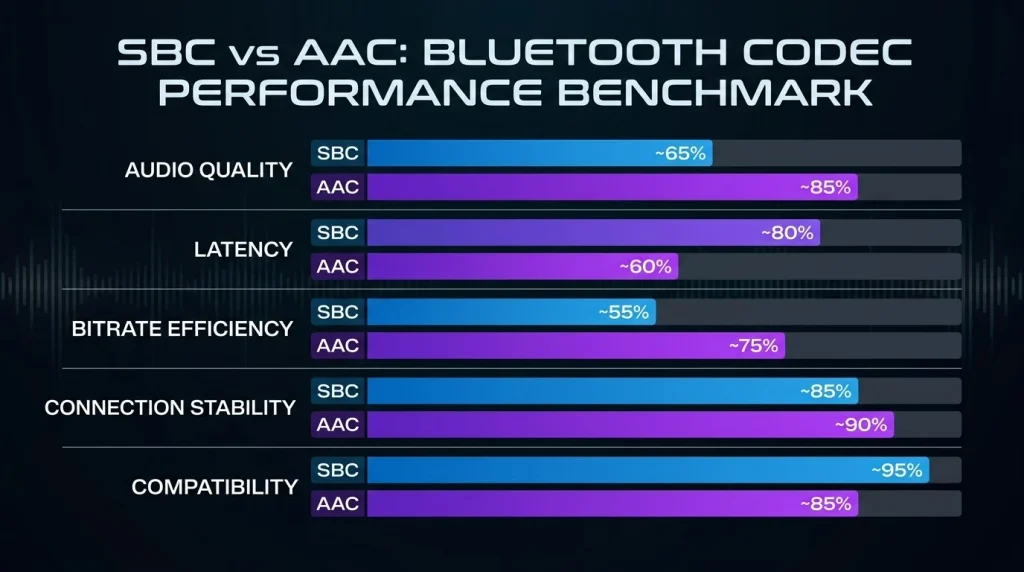
Sound quality is probably the biggest reason people search for an SBC vs AAC Bluetooth comparison.
Both codecs use lossy compression, so neither transmits a completely untouched copy of the original audio. However, AAC uses a more sophisticated compression design and can deliver very good perceived quality at appropriate bitrates.
With a quality AAC implementation, listeners may experience cleaner high frequencies, better preservation of musical details, and fewer noticeable compression artifacts compared with a poorly configured SBC connection.
However, the difference is not guaranteed to be dramatic.
For many everyday listeners, the quality of the headphones themselves will have a much greater effect. A well-designed pair of SBC earbuds can sound considerably better than poorly tuned AAC earbuds.
The recording quality also matters. Streaming highly compressed audio through an expensive codec does not magically restore details that are already missing from the source.
Which sounds better?
In general:
AAC has the potential to provide better perceived audio quality than SBC, particularly with a good implementation.
But the actual difference depends on the complete Bluetooth audio chain.
SBC vs AAC Bluetooth: Bitrate
Bitrate represents how much data is transmitted over a period of time. It is often used when discussing Bluetooth codecs, but bitrate alone should not be treated as a direct measurement of sound quality.
SBC can operate at different bitrates depending on the implementation and Bluetooth configuration. A commonly encountered high-quality SBC configuration can reach roughly the low-300-kbps range.
AAC also operates at varying bitrates depending on the platform and implementation. Consumer Bluetooth implementations commonly operate somewhere around the 128–256 kbps range, although the exact behavior can differ.
This creates an important misconception.
A higher bitrate does not automatically mean a codec sounds better.
Different codecs use different compression algorithms. AAC is designed to achieve strong perceptual quality efficiently, so comparing codecs purely by their numerical bitrate can produce misleading conclusions.
Instead, consider bitrate together with codec design, encoder quality, hardware implementation, and listening conditions.
SBC vs AAC Bluetooth: Compatibility
Compatibility is where SBC has one of its strongest advantages.
Because SBC is the baseline A2DP codec, it is supported by an enormous variety of Bluetooth audio equipment.
You can find SBC support in:
- Wireless earbuds
- Bluetooth headphones
- Portable speakers
- Smartphones
- Tablets
- Smart TVs
- Windows PCs
- Macs
- Car audio systems
- Gaming devices
- Older Bluetooth equipment
AAC is also widely supported, but its availability is not quite as universal.
Apple devices generally provide strong AAC support, while Android support is widespread but can vary between manufacturers, operating system versions, and hardware.
If you want the safest possible compatibility across different devices, SBC is the easier choice.
SBC vs AAC Bluetooth on iPhone
For Apple users, AAC is particularly relevant.
iPhones and other Apple devices have strong AAC support, and AAC has long been an important part of Apple’s Bluetooth audio ecosystem.
If you own an iPhone and your wireless earbuds support AAC, the connection will typically use AAC rather than falling back to SBC when AAC is available and appropriate.
This makes AAC a particularly important codec for people who primarily use Apple hardware.
For example, if you regularly use wireless earbuds with an iPhone, iPad, or Mac, AAC support is worth considering when purchasing Bluetooth headphones.
However, the presence of AAC does not mean every pair of AAC-compatible headphones will automatically sound excellent. Headphone tuning and hardware quality remain important.
SBC vs AAC Bluetooth on Android
Android is more complicated because there is greater hardware and software diversity.
Many modern Android smartphones support AAC, but implementation quality can vary. Different manufacturers can configure Bluetooth audio differently, and the behavior may depend on the specific device and software version.
Some Android phones also support additional codecs such as aptX, LDAC, or other manufacturer-specific solutions.
If your Android phone and earbuds both support AAC, AAC may provide excellent results. But you should not assume that AAC will always be the best available option simply because it has a more advanced compression design.
For Android users, checking the actual codec options supported by both devices is more useful than choosing based on the codec name alone.
SBC vs AAC Bluetooth: Latency
Latency is the delay between an action occurring on your device and the corresponding sound reaching your headphones.
This matters most when:
- Gaming
- Watching videos
- Playing musical instruments
- Editing audio
- Using interactive applications
Both SBC and AAC can introduce noticeable latency depending on the device and implementation.
SBC is often criticized for latency, but its actual latency can vary significantly based on buffering, Bluetooth hardware, operating system behavior, and configuration.
AAC also isn’t specifically designed as an ultra-low-latency gaming codec.
Therefore, if gaming latency is your primary concern, neither SBC nor AAC should automatically be considered an ideal solution.
Gaming-focused headphones and earbuds sometimes use dedicated low-latency wireless systems or specialized Bluetooth implementations to reduce delay.
For casual gaming
AAC and SBC can both be usable for casual mobile gaming.
For competitive gaming
A wired connection or dedicated low-latency wireless technology is generally more appropriate when synchronization and reaction time are critical.
SBC vs AAC Bluetooth: Video Watching
Video introduces another latency consideration.
If Bluetooth audio arrives slightly after the video image, the mismatch can become noticeable. Fortunately, modern devices often compensate for Bluetooth latency by adjusting video playback timing.
This means many people can watch YouTube, Netflix, movies, and other content without consciously noticing significant synchronization problems.
AAC can perform well for video, while SBC can also work perfectly acceptably when the device handles synchronization properly.
The quality of the implementation and the software’s ability to compensate for delay can matter more than simply choosing one codec over another.
SBC vs AAC Bluetooth: Battery Life
Both SBC and AAC are designed for efficient wireless audio transmission.
Battery consumption depends on much more than the codec itself.
Factors such as:
- Bluetooth radio power
- Transmission distance
- Volume level
- ANC usage
- Earbud processor
- Microphone activity
- Signal strength
- Codec implementation
- Earbud battery capacity
can all affect battery life.
AAC does not automatically mean shorter battery life, and SBC does not guarantee longer battery life.
For earbuds, active noise cancellation, transparency mode, microphone use, and overall hardware design can have a much greater effect on battery endurance.
SBC vs AAC Bluetooth: Connection Stability
SBC’s universal nature gives it an advantage when maximum compatibility is important.
If your headphones encounter a device that does not support AAC, the connection can fall back to SBC.
In real-world situations, Bluetooth stability is influenced by environmental interference, antenna quality, distance, device placement, Bluetooth version, and firmware.
Therefore, you should not assume that switching from SBC to AAC will automatically create a weaker or stronger connection.
A high-quality Bluetooth implementation can provide a stable AAC connection, while a poorly designed product may have problems regardless of codec.
SBC vs AAC Bluetooth for Music
For music listening, AAC is often an attractive choice, especially for Apple users.
Its compression technology is capable of preserving a high level of perceived audio quality at moderate bitrates.
However, SBC can also provide enjoyable music playback when implemented properly.
If you listen casually while commuting, exercising, or working, you may not notice a meaningful difference between SBC and AAC.
If you have high-quality headphones and listen carefully to high-quality source material, codec differences can become more relevant.
Still, headphone tuning usually remains one of the most important factors.
SBC vs AAC Bluetooth for Gaming
Neither SBC nor AAC is primarily designed as a competitive gaming codec.
Both can introduce latency, although the actual delay varies between devices.
For casual games, the difference may not matter.
For competitive games involving precise sound cues, a lower-latency wireless solution can be more appropriate.
If your earbuds have a dedicated gaming mode, that mode may change how audio is transmitted or buffered to reduce delay. The implementation can therefore matter more than whether the product lists SBC or AAC.
SBC vs AAC Bluetooth for Calls
Bluetooth calls involve more than the codec used for music playback.
Hands-free communication can use different Bluetooth profiles and audio processing. Microphone quality, noise suppression, echo cancellation, and voice-processing algorithms all affect call quality.
Consequently, choosing headphones solely because they support AAC does not guarantee better phone calls.
If calls are important, pay attention to microphone performance and the manufacturer’s voice-processing technology in addition to Bluetooth codec support.
Does AAC Always Sound Better Than SBC?
No.
This is one of the most important points in an SBC vs AAC Bluetooth comparison.
AAC has a more advanced compression design and can provide excellent quality, but the final result depends on implementation.
A high-quality SBC implementation can sound very good.
Likewise, an AAC implementation that is poorly optimized may not provide an obvious advantage.
Your listening experience also depends on:
- Headphone frequency response
- Driver quality
- Amplification
- DAC implementation
- Source quality
- Streaming service
- Bluetooth signal quality
- Device software
- Personal hearing
Therefore, AAC should generally be viewed as a potentially higher-quality option rather than an automatic guarantee of superior sound.
Quick Highlights Table
The following table summarizes the most important differences for everyday users.
| Category | SBC | AAC |
| Sound Quality | Good | Very good with good implementation |
| Compatibility | Excellent | Very good |
| Apple Devices | Supported | Excellent choice |
| Android Devices | Excellent | Widely supported |
| Windows | Excellent availability | Varies |
| Latency | Moderate | Moderate |
| Music | Good | Generally preferable |
| Gaming | Casual gaming | Casual gaming |
| Calls | Depends on device | Depends on device |
| Reliability | Very high compatibility | High |
| Complexity | Lower | Higher |
| Best Advantage | Universal support | Efficient high-quality audio |
Key Takeaways
Understanding the codec is useful, but it should not be the only factor when choosing wireless audio equipment.
- SBC is the universal Bluetooth audio baseline and offers excellent compatibility.
- AAC can provide excellent sound quality, especially on Apple devices.
- AAC does not automatically sound better than SBC in every implementation.
- Bitrate alone does not determine audio quality.
- SBC and AAC can both introduce latency.
- Neither codec should be considered a specialized competitive-gaming solution.
- Headphone tuning can have a much larger effect on sound than codec selection.
- Apple users should pay particular attention to AAC support.
- Android users should check the actual codec support of both their phone and headphones.
- For maximum device compatibility, SBC remains extremely useful.
- For music-focused Apple users, AAC support is particularly valuable.
- If your headphones support higher-end codecs, your phone’s supported codec list should also be considered.
Pros & Cons
Looking specifically at SBC vs AAC Bluetooth, each codec has strengths that make it suitable for different users and situations.
SBC Pros
- Extremely broad compatibility
- Supported by virtually all modern Bluetooth audio equipment
- Reliable baseline for wireless audio
- Good enough sound quality for many listeners
- No need for specialized hardware
- Works across many operating systems and device categories
SBC Cons
- Lossy compression
- Can introduce noticeable latency
- Audio quality depends heavily on implementation
- Not designed as a high-end audiophile codec
- Less efficient than some newer Bluetooth codecs
AAC Pros
- Efficient lossy compression
- Excellent support across Apple devices
- Can deliver very good perceived audio quality
- Widely available in modern headphones and earbuds
- Strong option for music listening
- Established audio format beyond Bluetooth
AAC Cons
- Implementation varies between platforms
- Not as universally supported as SBC
- Can have latency that is unsuitable for competitive gaming
- Requires licensing for implementation
- Android performance can vary between devices
Buying Recommendations
Choosing between SBC and AAC is easier when you consider how you actually use your headphones.
For iPhone Users
AAC support should be high on your checklist.
If you primarily use an iPhone, iPad, or Mac, choosing earbuds or headphones with AAC can make sense because Apple’s ecosystem has strong AAC support.
You should still prioritize sound tuning, comfort, microphone quality, battery life, and ANC performance.
For Android Users
Check both devices before making a decision.
If your Android phone supports AAC and your headphones support AAC, it can be a useful option. However, Android’s wide variety of hardware means implementation can vary.
If your headphones support other modern codecs, you may want to compare those options as well.
For Multi-Device Users
If you switch between smartphones, laptops, tablets, televisions, and other devices, SBC’s universal compatibility becomes particularly valuable.
AAC is still useful, but SBC provides an important compatibility fallback.
For Music Listeners
AAC is generally attractive when you have a high-quality implementation and compatible hardware.
However, don’t spend significantly more money solely for AAC if the alternative headphones have substantially better drivers or tuning.
For Gamers
Don’t select headphones purely because they support SBC or AAC.
Instead, look for products that specifically advertise low-latency operation or gaming modes.
If precise synchronization matters, dedicated low-latency wireless technology or wired audio can be more appropriate.
For Movie and Video Streaming
Either codec can work well for normal video consumption.
Prioritize headphones and devices that handle Bluetooth synchronization properly.
For Budget Earbuds
SBC support is perfectly acceptable.
If a budget pair of earbuds sounds good and is comfortable, the fact that it uses SBC does not automatically make it a poor choice.
Final Verdict
The SBC vs AAC Bluetooth comparison does not have one universal winner because the better choice depends on the devices, operating system, and listening requirements.
SBC wins in terms of universal compatibility and remains a perfectly usable Bluetooth audio codec for everyday listening. Its widespread support makes it an important fallback whenever a more advanced codec is unavailable.
AAC offers an efficient compression system and is particularly relevant for Apple users. With a good implementation, it can provide excellent music quality without requiring extremely high bitrates.
The most important takeaway is that AAC is not automatically superior to SBC in every real-world situation. Codec implementation, headphones, source audio, and device software all influence what you actually hear.
For an iPhone user choosing between otherwise similar products, AAC support is highly useful. For someone who values maximum compatibility across many devices, SBC remains essential. For serious gaming, neither should be selected solely for low latency.
Ultimately, Bluetooth codec support should be considered alongside the complete feature set rather than treated as the single measurement of headphone quality.
FAQs about AAC and SBC Bluetooth
Q1: What is the main difference between SBC and AAC Bluetooth?
Ans: SBC is the baseline Bluetooth audio codec designed for extremely broad compatibility, while AAC uses a more advanced compression approach and can provide very good perceived audio quality. AAC is particularly important in Apple’s Bluetooth ecosystem. However, actual sound quality depends on implementation, hardware, and source audio.
Q2: Is AAC better than SBC for Bluetooth audio?
Ans: AAC can provide better perceived audio quality than SBC when implemented well, but it is not guaranteed to sound better in every device combination. Headphone tuning, encoder quality, source audio, and operating-system implementation can significantly affect the result.
Q3: Is SBC good enough for music?
Ans: Yes. SBC can provide enjoyable music playback, especially when implemented properly. For everyday listening, many users may not notice a major difference between SBC and AAC. The quality of the headphones themselves can have a much greater impact on the overall sound.
Q4: Is AAC better for iPhone users?
Ans: AAC is particularly relevant for iPhone users because Apple devices have strong support for the codec. If your wireless headphones support AAC, it is a useful feature to have when using Apple hardware. You should still consider the headphones’ drivers, tuning, comfort, ANC, microphone, and battery life.
Q5: Which codec has lower latency, SBC or AAC?
Ans: Neither SBC nor AAC should automatically be considered a low-latency codec. Actual latency varies according to the device, Bluetooth implementation, buffering, operating system, and headphones. For competitive gaming, a dedicated low-latency wireless system or wired connection can be more appropriate.
Q6: Does AAC use more battery than SBC?
Ans: Not necessarily. Battery life depends on the Bluetooth radio, codec implementation, transmission conditions, ANC, microphone usage, volume, processor, and battery capacity. The difference between SBC and AAC alone generally should not be the primary factor when choosing earbuds based on battery life.
Q7: Should I choose SBC or AAC when buying Bluetooth earbuds?
Ans: Consider your devices first. AAC support is particularly useful for Apple users, while SBC provides extremely broad compatibility. If you use Android, check which codecs your specific phone and earbuds support. More importantly, compare sound tuning, comfort, battery life, microphone quality, ANC, reliability, and latency alongside codec support.
Short Conclusion
SBC and AAC are both capable Bluetooth audio codecs, but they serve slightly different priorities. SBC offers exceptional compatibility and dependable everyday performance, while AAC can deliver excellent audio quality and is especially well suited to Apple’s ecosystem. Rather than choosing a product based only on its codec, consider the entire audio system—including your phone, headphones, source quality, tuning, latency requirements, and features—to get the best real-world wireless listening experience.