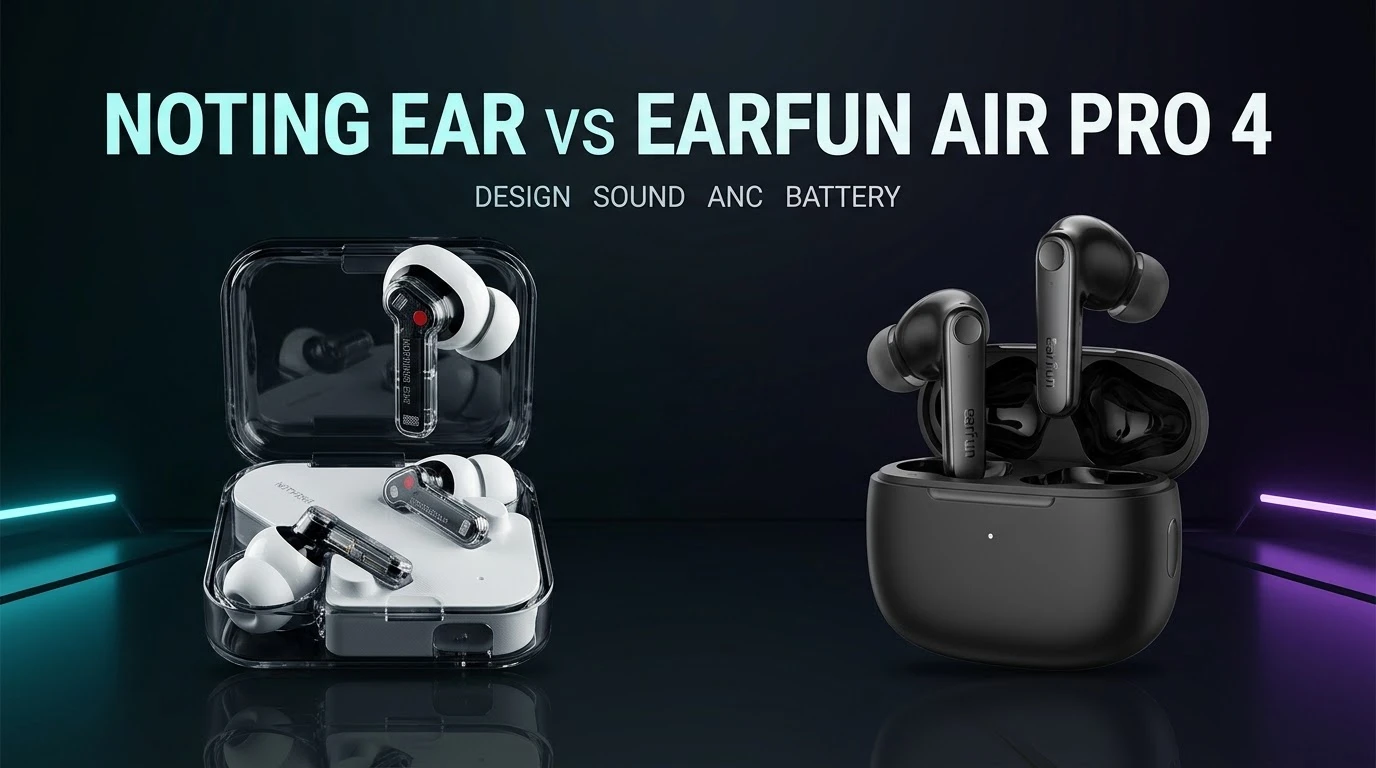
Choosing between the Nothing Ear and EarFun Air Pro 4 can be challenging because both wireless earbuds offer impressive sound, active noise cancellation (ANC), customizable settings, and convenient features for everyday listening. However, they approach the wireless audio experience differently. Nothing Ear stands out with its distinctive transparent design, detailed sound presentation, personalized audio options, and premium-feeling software experience. EarFun Air Pro 4 focuses on delivering a feature-rich package at a competitive price, with strong battery endurance, extensive Bluetooth codec support, and practical everyday functionality.
In this Nothing Ear vs EarFun Air Pro 4 comparison, we will examine the differences that matter most when choosing earbuds for music, commuting, gaming, work, and travel. We will compare their sound signatures, noise cancellation, microphone performance, battery life, connectivity, comfort, companion apps, and overall value. We will also explain which model makes more sense for Android users, iPhone owners, frequent travelers, and budget-conscious buyers. Neither pair is automatically the best choice for everyone. Your preferred sound, smartphone, budget, and daily listening habits will determine which earbuds offer the better experience.
Feature-by-Feature Comparison
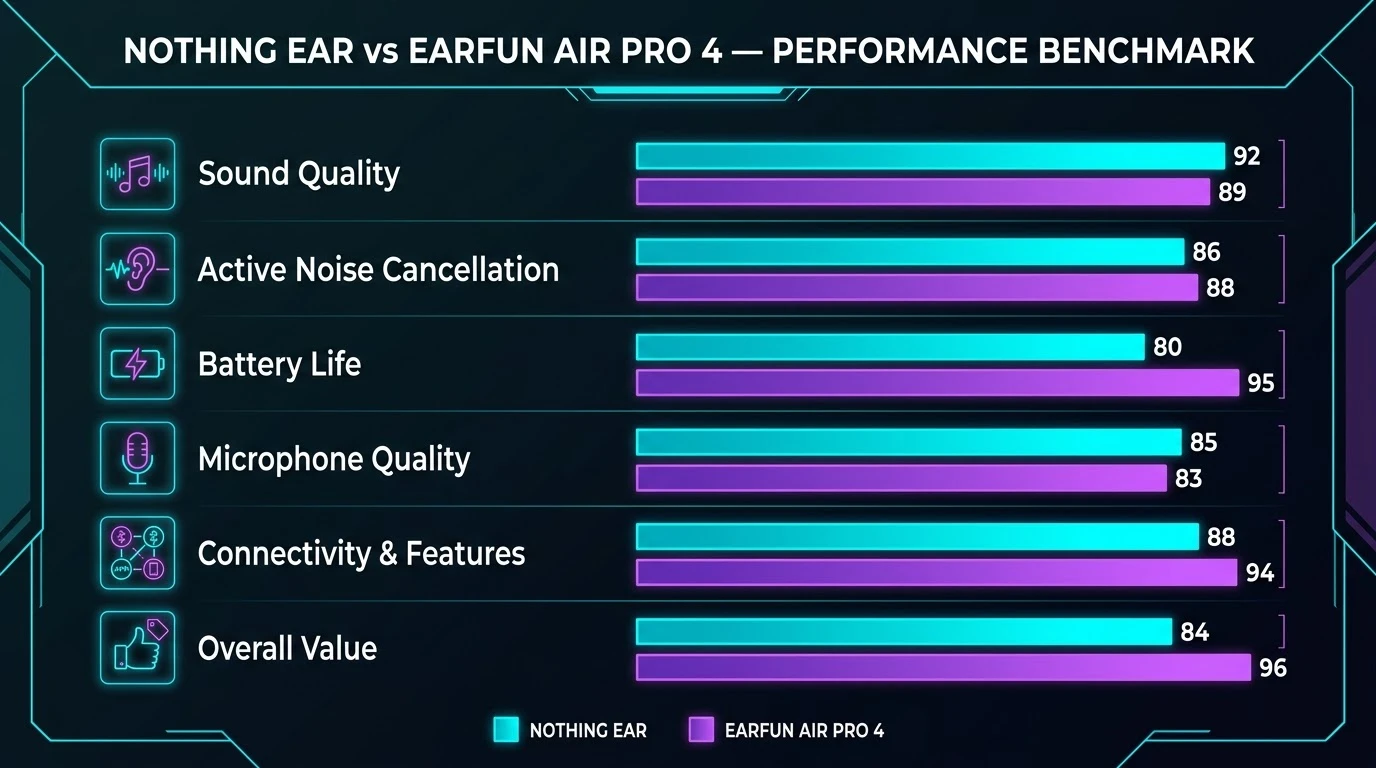
Both models compete in the premium-budget wireless earbud category, but their specifications and real-world strengths differ. The following table summarizes their main features, using manufacturer-rated figures where applicable. Actual performance varies depending on volume, codec, ANC settings, fit, and connected device.
| Feature | Nothing Ear | EarFun Air Pro 4 |
|---|---|---|
| Product category | True wireless earbuds | True wireless earbuds |
| Driver | 11mm dynamic driver | 10mm dynamic driver |
| Sound profile | Detailed, customizable, relatively balanced | Warm, energetic, bass-friendly |
| Active noise cancellation | Adaptive ANC, advertised up to 45 dB | Adaptive hybrid ANC, advertised up to 50 dB |
| Transparency mode | Yes | Yes |
| Bluetooth | Bluetooth 5.3 | Bluetooth 5.4 |
| Bluetooth codecs | SBC, AAC, LDAC | SBC, AAC, LDAC, aptX Adaptive, aptX Lossless and LC3 support, depending on firmware and device compatibility |
| Multipoint connectivity | Yes | Yes |
| Spatial audio | Yes, with compatible content and settings | No comparable dedicated spatial-audio feature |
| Personalized sound | Personalized sound profile and advanced EQ options | Custom EQ, presets, and sound customization |
| Battery, earbuds only | Up to 8.5 hours with ANC off | Up to 11 hours with ANC off |
| Total battery with case | Up to 40.5 hours with ANC off | Up to 52 hours with ANC off |
| Battery with ANC enabled | Lower than the ANC-off maximum | Lower than the ANC-off maximum |
| Wireless charging | Yes | Yes |
| Water and dust resistance | IP54 earbuds; IP55 charging case | IPX5 earbuds |
| Wear detection | Yes | Yes |
| Companion app | Nothing X | EarFun Audio |
| Best strength | Design, audio customization, and premium experience | Battery endurance, codec flexibility, and value |
| Typical price positioning | Generally more expensive | Generally more affordable |
Important: Battery figures are manufacturer claims rather than guaranteed real-world results. Codec availability can depend on firmware, region, and the phone or computer being used. The advertised ANC reduction figures also should not be treated as directly comparable laboratory measurements.
1. Design and Build Quality
Nothing Ear has one of the most recognizable designs in the wireless earbud market. Its transparent stems and charging case reveal parts of the internal structure, creating a modern, distinctive appearance. If you enjoy technology products that look different from conventional earbuds, Nothing’s design is a major attraction.
The earbuds are compact and relatively lightweight, making them suitable for daily listening and extended sessions. Their touch controls and polished companion app also contribute to the premium impression.
EarFun Air Pro 4 adopts a more conventional stem-style design. It does not have the same visual identity as Nothing Ear, but its practical shape suits everyday commuting, office work, and exercise. The charging case is functional, and the overall design prioritizes usability rather than making a visual statement.
Nothing Ear has an advantage if design and product identity matter to you. EarFun is a sensible alternative if you prefer a traditional appearance and would rather direct more of your budget toward useful audio features.
2. Sound Quality and Audio Performance
Sound quality is one of the most important factors in this comparison, and both earbuds can deliver enjoyable listening experiences.
Nothing Ear is designed to provide detailed audio with a good balance between bass, midrange, and treble. Its 11mm dynamic driver, supported by audio processing and EQ customization, helps create an engaging presentation across different music genres.
Vocals can sound clear and prominent, while instruments retain useful separation. Rock, acoustic music, podcasts, and pop tracks benefit from this balanced approach. The bass can also be adjusted to suit listeners who prefer a stronger low end.
EarFun Air Pro 4 offers a warmer, more energetic sound that can appeal to listeners who enjoy punchy bass and lively music. Electronic tracks, hip-hop, dance music, and modern pop can sound particularly engaging. Its customization options make it possible to adjust the presentation if the default tuning does not suit your preferences.
Neither model should be assumed to sound better simply because of its driver size or advertised specifications. Ear tips, seal quality, music mastering, and personal preference have a substantial influence on the experience.
Winner: Nothing Ear is a strong choice for listeners who value detail and a refined listening experience. EarFun Air Pro 4 is attractive for listeners who prefer energetic sound and extensive codec options.
3. Active Noise Cancellation
Active noise cancellation helps reduce unwanted background sounds by using microphones and electronic processing. It is particularly useful on buses, trains, airplanes, and in busy offices.
Nothing Ear offers adaptive ANC designed to respond to surrounding noise. It can make everyday listening more comfortable by reducing consistent low-frequency sounds, including some engine rumble and air-conditioning noise. Its effectiveness still depends on the frequency of the noise, the fit of the ear tips, and the surrounding environment.
EarFun Air Pro 4 uses hybrid ANC and advertises noise reduction of up to 50 dB. That headline figure is impressive, although maximum advertised reduction does not mean it will outperform every competitor in every situation. Independent testing and real-world listening conditions are more useful than comparing the largest numbers on packaging.
For everyday commuting, both models can reduce distractions. Neither should be expected to eliminate every nearby conversation, sudden sound, or high-pitched noise.
If ANC is your primary concern, test the fit carefully and consider independent measurements rather than relying solely on manufacturer claims. A poor seal can significantly reduce perceived noise cancellation.
Winner: EarFun Air Pro 4 is a compelling option for buyers prioritizing noise cancellation on a budget, while Nothing Ear remains competitive for general travel and office use.
4. Transparency Mode
Transparency mode allows outside sound to pass through the earbuds using their microphones. It is helpful when you need to hear announcements, speak to someone, or remain aware of your surroundings without removing your earbuds.
Nothing Ear provides a transparency mode that complements its ANC controls. It is useful for short conversations and situations in which you want to maintain awareness of the environment.
EarFun Air Pro 4 also supports ambient listening, giving users an alternative to switching between complete isolation and removing the earbuds.
The practical experience depends on how naturally each model reproduces outside voices and whether microphone processing introduces noticeable hiss or an artificial sound. Your fit and sensitivity to processed audio will also affect your preference.
Winner: Both offer the essential functionality. The better choice depends on which one reproduces voices more naturally for you.
5. Battery Life and Charging
Battery life is a major advantage for EarFun Air Pro 4. EarFun advertises up to 11 hours of playback from the earbuds with ANC disabled and up to 52 hours when combined with the charging case.
Nothing Ear is rated for up to 8.5 hours of playback with ANC disabled and up to 40.5 hours with the charging case. These figures make it suitable for regular daily listening, but EarFun offers more advertised endurance between charges.
Actual battery life will decrease when ANC is enabled, volume is high, or power-intensive Bluetooth codecs are used. Frequent calls can also shorten listening time.
Both models support wireless charging, adding convenience if you already have a compatible charging pad. USB-C charging remains useful for topping up the case at a desk or while traveling.
For someone who listens to music throughout the day, the EarFun’s larger advertised battery reserve can reduce charging frequency. Nothing Ear should still provide enough endurance for many daily commutes and typical listening sessions.
Winner: EarFun Air Pro 4. Its advertised battery life gives it a clear advantage for long listening sessions and frequent travel.
6. Bluetooth Connectivity and Codecs
Bluetooth codec support affects how audio is transmitted from your phone to your earbuds. The practical benefit depends on the source device, the codec being used, and the quality of the original recording.
Nothing Ear supports SBC and AAC alongside LDAC. LDAC can transmit higher-bitrate audio on compatible devices, making it particularly relevant to Android listeners who use high-quality music services or local audio files.
EarFun Air Pro 4 offers a broader selection of supported codecs, including LDAC and Qualcomm’s aptX family, alongside standard SBC and AAC. Supported aptX options and LC3 availability depend on the specific firmware and compatible hardware.
However, more codecs do not automatically mean better sound. An iPhone user, for example, generally relies on AAC or SBC rather than LDAC or aptX. In that situation, the additional Android-focused codecs offer little direct benefit.
Both models support multipoint connectivity, which allows the earbuds to maintain connections with two devices. This can be convenient when switching between a laptop and smartphone for work, although high-resolution codec modes may restrict multipoint functionality on some configurations.
Winner: EarFun Air Pro 4 for codec flexibility. Nothing Ear remains well equipped for listeners who primarily use compatible Android devices.
7. Microphone and Call Quality
Microphone quality matters if you frequently take calls while walking, working remotely, or attending online meetings.
Nothing Ear includes microphone processing designed to make speech clearer during calls. It can be useful for conversations in ordinary indoor environments and everyday outdoor situations. Its performance will still depend on wind, background voices, and the strength of your Bluetooth connection.
EarFun Air Pro 4 also includes multiple microphones and noise-reduction processing. This helps it handle ordinary calls and can reduce some surrounding noise. However, aggressive noise suppression can sometimes make speech sound less natural in difficult environments.
Neither model should be treated as a replacement for a dedicated headset if you regularly work in very noisy spaces or require consistently professional microphone quality.
For meetings, both are practical choices. If calls are particularly important, compare microphone samples recorded in quiet rooms, busy streets, and windy conditions rather than relying only on microphone counts.
Winner: There is no universal winner for every environment. Choose based on independent call tests that reflect where you usually make calls.
8. Comfort and Fit
Comfort is highly individual because ear shape, ear-tip size, and pressure sensitivity vary from person to person.
Nothing Ear’s compact design can make it comfortable for long listening sessions, especially when you find a suitable ear-tip size. A secure seal is essential not only for comfort but also for bass response and ANC performance.
EarFun Air Pro 4 has a stem-style design and interchangeable ear tips. It can provide a secure fit for everyday activities, although the shape may feel different from Nothing’s earbuds depending on your ears.
For both models, try the available ear tips and perform a gentle movement test before using them for exercise. If an earbud loosens while walking, sound quality and noise cancellation can deteriorate.
Winner: A tie. Fit depends more on your ears than on the brand, so choose the pair that feels secure without creating uncomfortable pressure.
9. App Features and Customization
The Nothing X app is a major part of the Nothing Ear experience. It provides access to audio settings, ANC modes, controls, firmware updates, and sound customization. Personalized sound options can help users adapt the earbuds to their listening preferences.
The EarFun Audio app also offers useful controls, including EQ adjustments, ANC settings, and firmware management. Its customization options are valuable for listeners who like adjusting the sound rather than accepting the default profile.
Nothing’s presentation and ecosystem integration may appeal to users who appreciate a polished interface, particularly those using compatible Nothing smartphones. EarFun focuses on offering a broad feature set without requiring a premium purchase.
App availability and individual features can change through firmware updates, so check the current software before buying.
Winner: Nothing Ear for a design-led, cohesive experience; EarFun Air Pro 4 for practical customization and value.
10. Water Resistance and Everyday Durability
Nothing Ear has an IP54 rating for the earbuds and an IP55 rating for the charging case. The earbuds are protected against dust ingress and water splashes within the limits of their rating.
EarFun Air Pro 4 has an IPX5 rating for the earbuds. This indicates protection against water jets under specified testing conditions, but the rating does not certify dust resistance.
Both are suitable for many everyday activities, including walking and light workouts, provided you follow their care instructions. Neither rating means the earbuds are waterproof, and water resistance can deteriorate with wear.
Avoid charging wet earbuds, exposing them to soap or salt water, or deliberately submerging them. Dry the earbuds and charging contacts before placing them in the case.
Winner: Nothing Ear offers the more clearly documented dust-and-water protection for the earbuds and case, while EarFun provides useful water resistance for everyday use.
11. Gaming and Video Latency
Both earbuds can handle casual mobile gaming and video playback, but wireless audio latency depends on the Bluetooth connection, device, codec, and game.
EarFun Air Pro 4 offers a low-latency gaming mode, making it worth considering for casual mobile games. Nothing Ear is also suitable for videos and many games, although competitive players should not assume either model provides the responsiveness of a dedicated wired gaming headset.
For watching videos, phones and apps often compensate for Bluetooth delay. Fast-paced games are more demanding because delayed sound can make actions feel disconnected from what appears on screen.
If gaming is a major reason for buying earbuds, test the latency with your actual phone and games. Do not assume that a high-resolution codec guarantees lower delay.
Winner: EarFun Air Pro 4 for users who value a dedicated gaming mode, although serious competitive gaming still favors specialized low-latency equipment.
Quick Highlights Table
Here is a quick summary of the most important differences for buyers who want a straightforward decision.
| Category | Better Choice | Reason |
|---|---|---|
| Design | Nothing Ear | Distinctive transparent appearance |
| Balanced listening | Nothing Ear | Refined, customizable presentation |
| Bass-focused listening | EarFun Air Pro 4 | Energetic, warm tuning |
| ANC value | EarFun Air Pro 4 | Strong advertised cancellation at a competitive price |
| Battery life | EarFun Air Pro 4 | Higher advertised playback figures |
| Codec variety | EarFun Air Pro 4 | Broader compatibility with supported audio codecs |
| App experience | Nothing Ear | Cohesive design and personalized audio features |
| Wireless charging | Tie | Both support it |
| Multipoint | Tie | Both support two-device connectivity |
| Dust protection | Nothing Ear | IP54-rated earbuds |
| Casual gaming | EarFun Air Pro 4 | Dedicated low-latency gaming mode |
| Budget-conscious buyers | EarFun Air Pro 4 | Often offers more features for the money |
Key Takeaways
The Nothing Ear vs EarFun Air Pro 4 comparison shows that the better earbuds depend on your priorities rather than one specification alone. Both offer ANC, multipoint connectivity, app-based customization, wireless charging, and sound quality suitable for everyday listening.
Here are the main points to remember:
- Choose Nothing Ear for design: Its transparent styling is distinctive, and its software experience feels cohesive.
- Choose EarFun Air Pro 4 for battery life: Its advertised playback figures are higher, reducing how often you need to charge.
- Consider EarFun for codec flexibility: It supports a wider selection of Bluetooth audio formats on compatible devices.
- Compare sound preferences: Nothing offers a detailed, customizable presentation, while EarFun appeals to listeners who enjoy lively, bass-friendly audio.
- Check your smartphone: Many advanced codecs are unavailable on certain devices, so codec support should match your actual setup.
- Do not buy based only on ANC numbers: Fit and independent testing are more meaningful than maximum advertised decibel figures.
- Think about your daily routine: Commuters, office workers, travelers, and casual gamers may prioritize different features.
Pros & Cons: Nothing Ear vs EarFun Air Pro 4
Both models have meaningful advantages, but they also involve trade-offs. The following pros and cons highlight what you should consider before making a purchase.
Nothing Ear Pros and Cons
Pros
- Distinctive transparent design and modern appearance.
- Detailed, engaging sound with personalization options.
- LDAC support for compatible Android devices.
- Adaptive active noise cancellation.
- Multipoint Bluetooth connectivity.
- Wireless charging and wear detection.
- IP54-rated earbuds and IP55-rated charging case.
- Useful app features and a polished software experience.
Cons
- Usually costs more than EarFun Air Pro 4.
- Advertised battery life is lower than EarFun’s.
- Advanced codec benefits depend on device compatibility.
- ANC cannot eliminate all surrounding noise.
- Transparent styling may not appeal to everyone.
EarFun Air Pro 4 Pros and Cons
Pros
- Strong advertised battery life, including up to 52 hours with the case and ANC disabled.
- Hybrid ANC with an advertised maximum reduction of up to 50 dB.
- Broad codec support for compatible Android devices.
- Custom EQ and sound presets through the companion app.
- Multipoint connectivity for switching between devices.
- Wireless charging and wear detection.
- Low-latency gaming mode.
- Often offers excellent value for its feature set.
Cons
- More conventional design than Nothing Ear.
- Actual battery life can be significantly lower with ANC and high-bitrate codecs enabled.
- Advanced codec features may require compatible hardware or firmware.
- Noise reduction can sometimes affect the naturalness of calls.
- IPX5 protection does not include a certified dust-resistance rating.
Buying Recommendations: Which Earbuds Should You Choose?
The best option depends on how you plan to use your earbuds. Instead of choosing the model with the longest specification list, match its strengths to your daily needs.
Choose Nothing Ear If You Want Premium Design and Customizable Sound
Nothing Ear is a good choice if appearance, software design, and audio personalization are high priorities. Its transparent styling stands out, while its EQ and personalized sound features allow you to adjust the listening experience.
It is especially attractive for Android users who can take advantage of LDAC. It also suits listeners who want a distinctive product that feels more premium than many conventional budget earbuds.
Choose it if you value design and a refined everyday experience enough to justify paying more when the price difference is substantial.
Choose EarFun Air Pro 4 If Battery Life Matters Most
EarFun Air Pro 4 is the stronger option for people who listen for several hours daily. Its advertised battery endurance is higher, and its feature set is extensive for its typical price category.
It is particularly attractive to commuters, students, remote workers, and travelers who want ANC, multipoint, wireless charging, and customizable sound without moving into a more expensive price bracket.
If both models are available and the EarFun costs noticeably less, it can deliver better overall value for practical everyday listening.
Choose EarFun Air Pro 4 for Android Codec Flexibility
Listeners using compatible Android phones may benefit from EarFun’s wider codec selection. Support for LDAC and supported aptX formats provides flexibility for different devices and audio preferences.
However, do not pay extra just to obtain a codec you cannot use. Check your phone’s Bluetooth audio settings and confirm which formats it supports.
Consider Nothing Ear for Design-Conscious Buyers
If you want earbuds that look different from the usual black or white designs, Nothing Ear has a clear advantage. Its transparent appearance, compact charging case, and matching software make it appealing to people who value product design as much as specifications.
For Travel, Work, and Daily Commuting
Both earbuds are capable travel companions. EarFun’s advertised battery life is especially appealing for longer days, while Nothing offers a distinctive design and customizable listening experience.
For office use, multipoint is helpful when moving between a laptop and smartphone. For commuting, ANC and fit matter more than small differences in driver size or maximum advertised noise reduction.
Which Is Better for iPhone Users?
iPhone owners should focus on comfort, sound quality, ANC, battery life, and microphone performance rather than Android-focused codecs. AAC support provides a straightforward wireless listening option on both models.
EarFun’s extra codec support is less important if your phone cannot use those formats. In that case, the best choice comes down to pricing, fit, and which sound signature you prefer.
Which Offers Better Value?
EarFun Air Pro 4 is often the better value when its price is substantially lower than Nothing Ear. It provides an extensive collection of features and longer advertised battery life without requiring a premium design-focused purchase.
Nothing Ear can still be worth the extra money if you specifically value its appearance, sound personalization, and overall product experience.
Before buying either model, compare current prices, warranty coverage, return policies, and local availability. Prices can vary considerably between retailers and countries.
Final Verdict: Nothing Ear vs EarFun Air Pro 4
The Nothing Ear vs EarFun Air Pro 4 comparison comes down to premium design and a refined listening experience versus practical features and value.
Nothing Ear is the better fit for buyers who appreciate transparent styling, customizable sound, and a cohesive companion app. Its audio capabilities and adaptive ANC make it a strong everyday option, especially for listeners who want earbuds that feel distinctive rather than ordinary.
EarFun Air Pro 4 is the more practical choice for many budget-conscious buyers. Its higher advertised battery life, extensive codec support, hybrid ANC, multipoint connectivity, and gaming mode create an appealing all-round package. If you want a lot of functionality without spending more than necessary, it deserves serious consideration.
Our recommendation: EarFun Air Pro 4 for overall value, battery life, and feature variety. Nothing Ear for design, personalization, and a more distinctive product experience.
Neither is the universal winner. If the EarFun is significantly cheaper, it is difficult to ignore its value. If you prefer Nothing’s design and find its sound more enjoyable, paying extra can still make sense.
FAQs about Nothing Ear and EarFun Air Pro 4
Q1: Which is better, Nothing Ear or EarFun Air Pro 4?
Ans: EarFun Air Pro 4 is generally the better value because it offers longer advertised battery life, extensive codec support, hybrid ANC, and useful features at a competitive price. Nothing Ear is a better match for buyers who prioritize distinctive design, sound personalization, and a polished software experience.
Q2: Which earbuds have better noise cancellation?
Ans: EarFun Air Pro 4 advertises hybrid ANC with up to 50 dB of noise reduction, while Nothing Ear advertises adaptive ANC up to 45 dB. Those figures do not guarantee a specific real-world result. Ear-tip fit, noise frequency, and testing conditions affect performance, so independent comparisons are more useful than headline numbers alone.
Q3: Which has better sound quality?
Ans: Both can sound excellent for everyday listening. Nothing Ear is attractive for listeners who prefer detailed, customizable sound, while EarFun Air Pro 4 suits those who enjoy a warm, energetic presentation. The best choice depends on your music preferences, EQ settings, and fit.
Q4: Does EarFun Air Pro 4 have better battery life than Nothing Ear?
Ans: Yes, according to manufacturer-rated figures. EarFun advertises up to 11 hours from the earbuds and 52 hours with the charging case when ANC is disabled. Nothing Ear advertises up to 8.5 hours from the earbuds and 40.5 hours with the case under comparable ANC-off conditions. Real-world results will vary.
Q5: Which earbuds are better for Android phones?
Ans: Both work well with compatible Android devices. EarFun Air Pro 4 offers a broader range of supported Bluetooth codecs, including compatible aptX options, while Nothing Ear supports LDAC. Your phone’s hardware and software determine which codecs you can actually use.
Q6: Are Nothing Ear and EarFun Air Pro 4 good for gaming?
Ans: Both are suitable for casual gaming and video playback. EarFun Air Pro 4 includes a low-latency gaming mode, which makes it appealing for mobile gaming. Neither should be assumed to match the responsiveness of a dedicated wired gaming headset, especially in competitive games.
Q7: Which should I buy if I have a limited budget?
Ans: EarFun Air Pro 4 is usually the more sensible purchase when it costs noticeably less than Nothing Ear. It combines ANC, long advertised battery life, multipoint connectivity, wireless charging, and broad codec support. However, compare local prices and warranty coverage before deciding, because regional discounts can change which model offers the best deal.
Short Conclusion
Nothing Ear and EarFun Air Pro 4 are both capable wireless earbuds, but they appeal to different buyers. Nothing Ear stands out for its transparent design, audio customization, and premium-feeling experience. EarFun Air Pro 4 delivers excellent practical value through longer advertised battery life, flexible connectivity, and a broad feature set.
For most buyers who want capable ANC earbuds without spending unnecessarily, EarFun Air Pro 4 is our value-focused recommendation. If you care more about distinctive design and Nothing’s personalized audio experience, Nothing Ear is worth considering instead. Compare their current prices, try the fit if possible, and choose the model that best matches your listening habits.