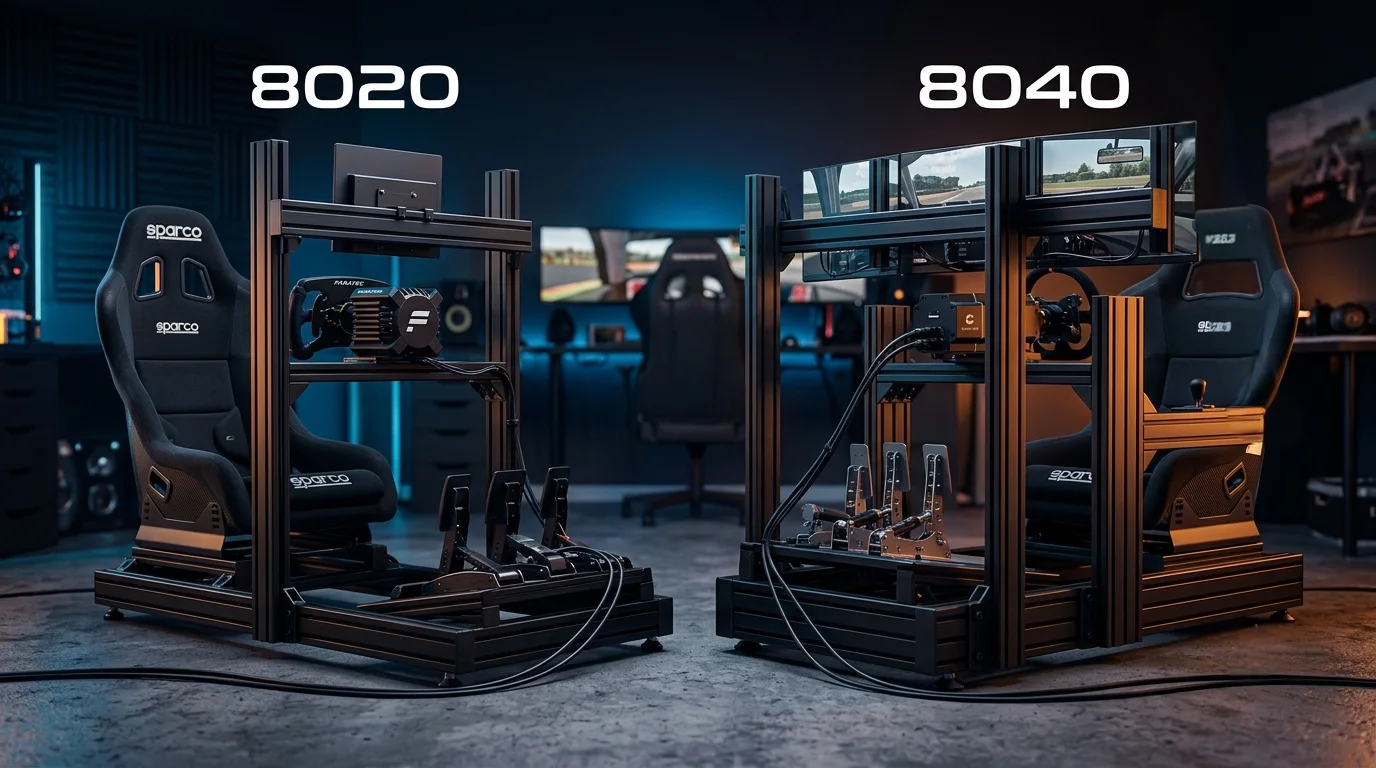
Choosing between an 8020 vs 8040 sim rig can be confusing, especially because “8020” is often used as a general term for aluminum extrusion cockpits rather than a precise profile size. In actual construction, an 80×20 mm profile is considerably different from an 80×40 mm profile, with the latter offering a deeper cross-section and generally greater resistance to bending and twisting.
For sim racers, the difference becomes particularly important when using stronger direct-drive wheelbases, stiff load-cell pedals, large monitor mounts, or accessories that add leverage to the frame. An 8040-style profile is widely used in dedicated aluminum-profile cockpits because it provides a strong combination of rigidity, adjustability, and modularity.
However, bigger does not automatically mean better for every setup. An 8020-style construction can make sense for lighter equipment, compact builds, or budget-conscious DIY projects. This guide compares the two approaches across frame stiffness, wheelbase compatibility, pedal support, adjustability, installation, upgrades, cost, and long-term usability.
Important terminology: “80/20” or “8020” can refer to the 80/20 Inc. brand or be used generically for aluminum-profile rigs. Always check the actual extrusion dimensions before buying.
Feature-by-Feature Comparison Table
Before choosing between an 8020 vs 8040 sim rig, it helps to understand that profile dimensions are only one part of overall rigidity. Joint design, bracing, mounting plates, profile length, fasteners, and frame geometry also have a major effect on how a cockpit behaves.
| Feature | 8020-Style Profile | 8040-Style Profile |
| Typical profile | 80×20 mm | 80×40 mm |
| Cross-section depth | 20 mm | 40 mm |
| Overall rigidity | Moderate | High |
| Weight | Lower | Higher |
| Material usage | Lower | Higher |
| Direct-drive suitability | Entry to moderate setups | Moderate to high-torque setups |
| Load-cell pedal support | Depends heavily on bracing | Generally stronger |
| Wheel deck stability | Good with proper design | Excellent with proper design |
| Torsional resistance | Lower | Higher |
| DIY friendliness | Excellent | Excellent |
| Adjustability | Excellent | Excellent |
| Accessory mounting | Very flexible | Very flexible |
| Monitor mounting | Suitable with reinforcement | Better for heavy mounts |
| Upgrade potential | Good | Excellent |
| Footprint | Can be compact | Can be slightly bulkier |
| Assembly | Moderate | Moderate |
| Portability | Easier | Heavier |
| Best use | Lightweight/compact builds | Dedicated performance rigs |
| High-torque DD | Design-dependent | Better suited |
| Motion platform | Requires careful engineering | Better foundation, depending on design |
| Long-term upgrade flexibility | Good | Excellent |
Quick Highlights Table
The biggest distinction in an 8020 vs 8040 sim rig comparison is the additional 20 mm of profile depth in the 8040 configuration. That extra material can significantly improve stiffness, although the complete frame design still determines the final result.
| Category | 8020 | 8040 |
| Rigidity | Good | Excellent |
| Weight | Lower | Higher |
| DIY Cost | Lower | Higher |
| Direct Drive | Best for lower torque | Better for higher torque |
| Load-Cell Pedals | Good with bracing | Excellent |
| Adjustability | Excellent | Excellent |
| Upgradeability | Very good | Excellent |
| Compact Builds | Better | Good |
| Heavy Accessories | Requires reinforcement | Better suited |
| Long-Term Build | Good | Excellent |
Key Takeaways
The difference between these two profiles is not simply about which number looks larger. The actual dimensions, frame layout, connection method, and intended equipment all matter.
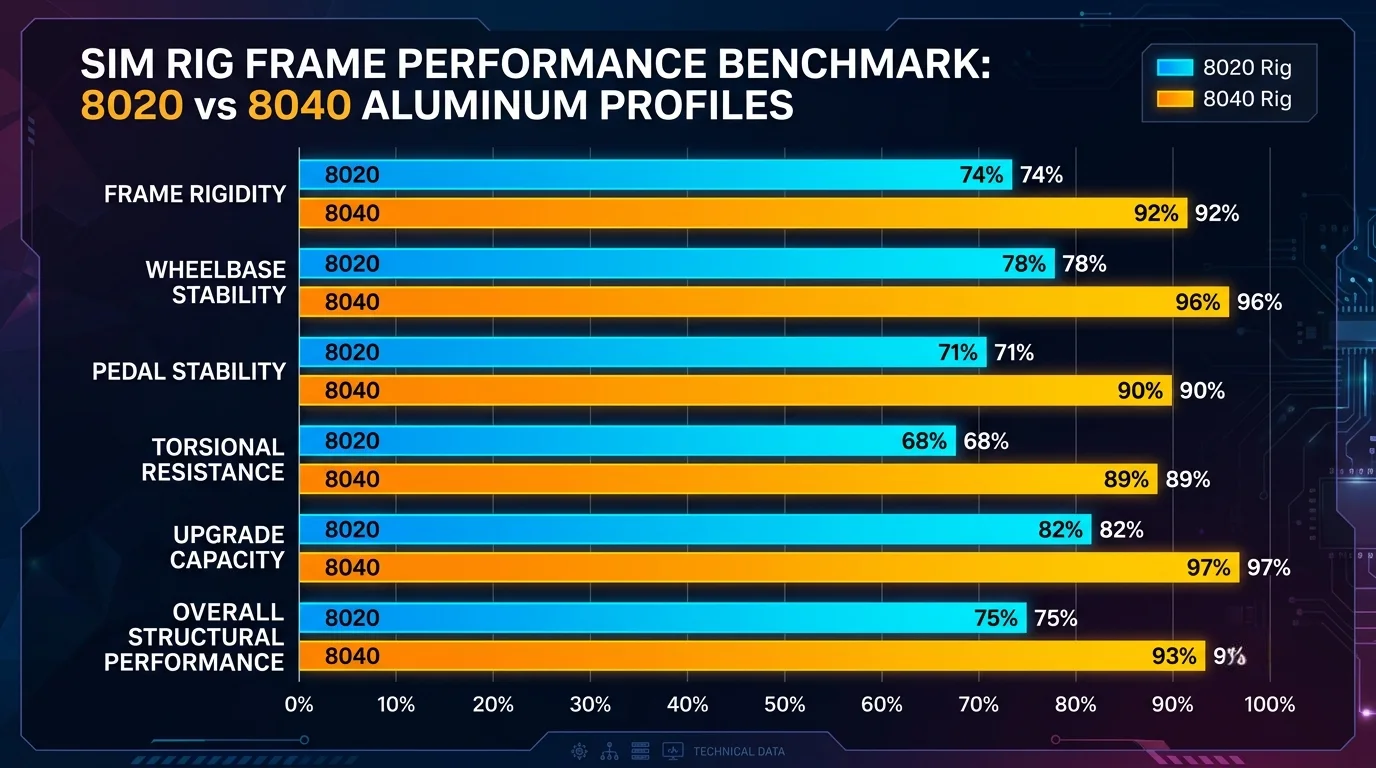
Here are the most important points:
- 8040 means an approximately 80×40 mm profile, while an 80×20 mm profile is substantially shallower.
- A deeper 8040 profile generally provides greater bending and torsional resistance than an 80×20 profile.
- Aluminum extrusion rigs are highly adjustable because T-slots allow components to be repositioned along the frame.
- Wheelbase torque matters. A stronger direct-drive base puts more stress on the wheel deck and surrounding structure.
- Pedal stiffness matters just as much as wheelbase support. Load-cell pedals can put substantial force through the pedal deck.
- 8040 is a strong choice for people planning a dedicated cockpit with future hardware upgrades.
- An intelligently braced 8020-style design can still work very well for lower-powered equipment.
- Profile size alone does not guarantee a rigid rig. Joint construction, bracing, mounting plates, and geometry can change the result considerably.
- Check whether the profile is metric or imperial before buying additional extrusion and hardware because compatibility is not automatically guaranteed between different systems.
Understanding 8020 and 8040 Aluminum Profiles
One of the biggest sources of confusion is the terminology.
The term 8020 has multiple meanings in sim racing. 80/20 is also the name of a manufacturer of T-slot aluminum extrusion, while sim racers frequently use “8020” as a generic description for aluminum-profile cockpits. It does not necessarily mean that every 8020-style rig uses an 80×20 mm extrusion.
For this comparison, we are using:
- 8020: 80×20 mm aluminum extrusion
- 8040: 80×40 mm aluminum extrusion
The 8040 profile is twice as deep in one dimension. That additional depth can substantially improve resistance to bending, particularly when the extrusion is used as a main structural member.
This is why many dedicated sim racing cockpits use 40×80 mm or similar larger profiles rather than relying exclusively on shallow 80×20 mm sections.
There are also larger profiles such as 40×120 mm and 40×160 mm. These can be appropriate for extremely high-torque systems or specialized motion applications, but using oversized extrusion everywhere is not necessarily necessary.
Rigidity and Frame Flex
Rigidity is arguably the most important consideration when comparing an 8020 vs 8040 sim rig.
A sim racing cockpit needs to keep the wheel, pedals, and seat in consistent positions while force is being applied. If the wheel deck moves noticeably when you turn the steering wheel, or the pedal platform bends during hard braking, some of your input force is effectively being spent moving the cockpit instead of controlling the simulator.
The deeper 8040 profile generally has an advantage here.
Because the cross-section is larger, the structural member can resist bending and twisting more effectively than a comparable 80×20 member. This becomes increasingly relevant as wheelbase torque and pedal force increase.
However, it is important not to oversimplify this into “8040 always has no flex.”
A poorly designed 8040 cockpit can still flex. A long unsupported beam, weak brackets, insufficient bolts, or a poorly supported wheel deck can compromise rigidity. Conversely, an intelligently designed 8020 structure can be surprisingly strong.
The complete architecture matters.
Direct-Drive Wheel Compatibility
Direct-drive wheels have made cockpit rigidity much more important.
Entry-level systems may produce relatively modest torque, while stronger direct-drive bases can generate considerably more force. A cockpit designed around a lower-powered wheelbase may not provide the same experience when upgraded to a much stronger system.
An aluminum-profile cockpit is attractive because it can be modified as your hardware evolves.
For an 8020-style frame, the suitability of a direct-drive wheelbase depends heavily on:
- Profile thickness
- Wheel deck design
- Upright spacing
- Bracket strength
- Cross-bracing
- Fastener quantity
- Wheelbase mounting method
- Overall frame geometry
An 8040 configuration provides a larger structural foundation, making it a sensible option when you expect to move into stronger direct-drive hardware.
For example, published sim-racing guidance commonly places aluminum-profile rigs in the category of systems intended for higher-torque direct-drive hardware, while lower-torque wheels can work with a much wider range of cockpit designs.
Load-Cell Pedals and Braking Performance
Wheelbase torque gets most of the attention, but pedal force can be just as important.
Load-cell pedals measure braking pressure rather than simply relying on pedal travel. Strong braking can transfer substantial force through the pedal plate and into the cockpit.
A flexible pedal deck can therefore become a problem even if your wheelbase itself is relatively modest.
This is another area where 8040 has an advantage. A well-designed 8040 pedal structure can provide a strong foundation for stiff pedals and load-cell systems.
But again, the profile is not everything.
A strong extrusion connected with weak brackets can still move. For serious pedal setups, look for:
- Thick pedal mounting plates
- Short unsupported spans
- Multiple attachment points
- Strong corner brackets
- Cross-members beneath the pedal area
- Secure connections between the pedal deck and main frame
The goal is to keep the pedal position stable under heavy braking.
Adjustability and Customization
This is where both 8020 and 8040 designs perform extremely well.
Unlike many welded tubular cockpits, aluminum extrusion systems use T-slots that allow components to be mounted and repositioned along the profile. Wheel decks, pedal platforms, seat mounts, shifter brackets, handbrakes, monitor arms, and accessories can all be adjusted.
That makes aluminum extrusion particularly useful if multiple people use the same rig.
You can adjust:
- Wheel height
- Wheel distance
- Pedal distance
- Pedal angle
- Seat position
- Shifter position
- Handbrake position
- Monitor height
- Monitor distance
- Keyboard tray position
Both profiles provide this fundamental advantage.
Therefore, moving from 8020 to 8040 does not mean giving up modularity. You are primarily increasing the structural capacity of the frame.
Weight and Portability
If portability matters, an 8020-style rig can have an advantage.
Smaller extrusion generally uses less aluminum, which can reduce the overall weight of the cockpit. This is useful for people who need to move their rig regularly or store it when not racing.
An 8040 rig is typically heavier because the profile contains more material.
That extra weight is not necessarily a disadvantage for a permanent racing setup.
In fact, a heavier, more rigid cockpit can feel more planted during aggressive steering and braking. But if your rig needs to be moved frequently, weight becomes an important consideration.
Think about your environment before choosing the profile.
For a dedicated sim room, the additional weight of 8040 may be insignificant. For a bedroom or shared living space where the rig needs to be moved after every session, a lighter construction can be more convenient.
DIY Construction
Both profiles are excellent for DIY projects.
The modular nature of aluminum extrusion means you can build a cockpit around your exact requirements rather than adapting yourself to a fixed frame.
However, DIY builders should not simply purchase extrusion based on dimensions.
Before ordering anything, determine:
- Wheelbase mounting requirements
- Pedal dimensions
- Seat mounting pattern
- Desired seating position
- Shifter and handbrake location
- Monitor mounting method
- Available room
- Desired wheelbase torque
- Future upgrades
- Required bracing
One of the advantages of aluminum extrusion is that you can make changes later, but incorrect planning can still result in unnecessary hardware costs.
You also need to ensure that your T-nuts, bolts, brackets, and extrusion are compatible. Different profile systems can have different slot dimensions and hardware standards.
Monitor Mounting
Your monitor setup should also influence the decision.
A single lightweight monitor mounted independently from the cockpit places relatively little demand on the rig.
A large ultrawide display, triple-monitor arrangement, or integrated monitor stand creates much more leverage.
If your monitor mount is attached directly to the rig, a stronger 8040-based structure can be useful because it provides a better foundation for heavier equipment.
However, the monitor support itself is critical.
There is little benefit in using a very large main frame if the monitor upright is mounted using a weak bracket or excessively long unsupported extrusion.
For triple-screen users, consider the entire support structure rather than just the profile size.
Space Requirements
An 8020 vs 8040 sim rig comparison should also consider room size.
The difference in profile dimensions may appear small, but dedicated rigs can become large once you add:
- Seat
- Wheelbase
- Pedals
- Shifter
- Handbrake
- Monitor stand
- Keyboard tray
- Speakers
- Cable management
- Accessories
If you have limited floor space, a compact aluminum-profile design may be more practical.
If space is not a concern, 8040 gives you more freedom to build a robust dedicated cockpit without worrying as much about structural limitations.
Upgrade Potential
Upgrade potential is one of the strongest reasons to consider aluminum extrusion.
You might start with a modest wheelbase and basic pedals, then eventually upgrade to:
- A stronger direct-drive wheel
- Load-cell pedals
- Hydraulic or high-end pedals
- Sequential shifter
- H-pattern shifter
- Handbrake
- Button boxes
- Larger monitor
- Triple screens
- Bass shakers
- Additional accessories
A well-designed aluminum cockpit can accommodate these changes without requiring an entirely new frame.
This makes 8040 particularly attractive if you already know that you want a long-term dedicated setup.
Instead of designing around your current equipment alone, you can build around the equipment you expect to use several years from now.
8020 vs 8040 Sim Rig: Cost Considerations
An 8020-style frame can potentially cost less because it uses less material.
However, the final price of a DIY cockpit depends on much more than extrusion.
Your total cost can include:
- Aluminum profiles
- Corner brackets
- T-nuts
- Bolts
- Wheel mounting plate
- Pedal plate
- Seat brackets
- Seat rails
- Shifter brackets
- Monitor mounts
- Cable-management accessories
- Shipping
This is particularly important when ordering aluminum extrusion online because long and heavy components can make shipping expensive.
An 8040 build may cost more initially, but the additional structural capacity can make sense if you intend to keep upgrading the cockpit.
Pros & Cons
When looking at the 8020 vs 8040 sim rig debate, neither profile is automatically suitable for every driver. Your hardware, available space, budget, and future plans should determine the choice.
8020-Style Rig Pros
- Lower material usage
- Potentially lower cost
- Lower overall weight
- Easier to move
- Excellent modularity
- Highly customizable
- Good for compact DIY builds
- Suitable for many entry-level and moderate setups
8020-Style Rig Cons
- Lower rigidity than a comparable 8040 member
- Requires more attention to bracing
- Less structural margin for high-torque hardware
- Heavy accessories may require reinforcement
- DIY design becomes more important as hardware gets stronger
8040-Style Rig Pros
- Greater structural rigidity
- Better resistance to bending
- Better suited to stronger direct-drive bases
- Strong foundation for load-cell pedals
- Excellent long-term upgrade potential
- Works well for dedicated cockpits
- Better suited to heavy accessories
8040-Style Rig Cons
- Heavier
- Uses more aluminum
- Can cost more
- Less convenient to move
- May be unnecessary for basic wheelbases
- Larger structural members can make compact designs more difficult
Buying Recommendations
The best choice depends on what you intend to build.
For Entry-Level Sim Racers
If you are using a relatively low-powered wheel and standard pedals, you do not necessarily need the largest profile available.
An intelligently designed 8020-style rig can provide a substantial improvement over a basic desk-mounted setup while retaining excellent adjustability.
For a first dedicated cockpit, prioritize good geometry and secure mounting rather than simply choosing the biggest extrusion.
For 5–10 Nm Direct Drive
This is where your decision becomes more interesting.
A good 8020-style construction may work, but the wheel deck and uprights need to be designed carefully.
If the price difference is manageable, moving to 8040 provides additional structural margin and can make future upgrades easier.
For Higher-Torque Direct Drive
For stronger direct-drive hardware, an 8040-based cockpit makes more sense as a starting point.
The objective is not simply to prevent catastrophic movement. A rigid rig also helps keep your wheelbase, seat, and pedals consistent during repeated steering and braking inputs.
For very high torque levels, however, do not assume that 8040 everywhere is automatically sufficient. Larger profiles, additional bracing, and specialized cockpit designs may be appropriate depending on the hardware.
For Load-Cell Pedals
Choose the design with the strongest pedal support.
If comparing two otherwise similar frames, 8040 provides a useful structural advantage, but examine the pedal tray construction and mounting method as well.
For DIY Builders
8020 can be attractive when keeping costs and weight under control.
8040 is more appealing when you are building a permanent cockpit and want additional structural capacity.
In either case, carefully calculate the extrusion lengths and hardware before ordering.
For Future Upgrades
If you already know that your current wheel is only temporary, consider designing for the future.
A cockpit that comfortably handles stronger hardware can prevent you from rebuilding the entire frame later.
This is one of the strongest arguments for choosing an 8040-based architecture.
Final Verdict
The 8020 vs 8040 sim rig choice ultimately comes down to structural requirements rather than simply choosing the larger number.
An 80×20 mm profile can be useful for lightweight, compact, and carefully braced sim racing builds. It offers the same fundamental modular advantages of aluminum extrusion and can be a sensible option when the wheelbase and pedals do not demand extreme structural rigidity.
An 80×40 mm 8040-style profile provides a larger structural cross-section and is generally better suited to dedicated cockpits, stronger direct-drive systems, stiff pedals, and future hardware upgrades.
For a long-term dedicated sim racing setup, the additional rigidity and upgrade headroom of 8040 can be valuable. For a lighter or budget-oriented setup, 8020-style construction can still make sense.
Most importantly, do not judge a cockpit solely by the profile number. Joint design, bracing, wheel-deck construction, pedal support, fasteners, profile orientation, and overall geometry can make a major difference.
FAQ
Q1: What is the main difference between an 8020 and 8040 sim rig?
Ans: The primary difference is the extrusion cross-section. In this comparison, 8020 refers to approximately 80×20 mm aluminum profile, while 8040 refers to approximately 80×40 mm profile. The deeper 8040 section generally provides greater resistance to bending and twisting.
Q2: Is 8040 better than 8020 for direct-drive wheels?
Ans: 8040 generally provides more structural rigidity and therefore offers more headroom for stronger direct-drive wheelbases. However, the complete cockpit design matters. Bracing, wheel-deck construction, brackets, fasteners, and mounting geometry can significantly affect the final rigidity.
Q3: Can an 8020 sim rig handle a direct-drive wheel?
Ans: Yes, depending on the actual profile, construction, and wheelbase torque. Lower and moderate-torque systems can be used with appropriately designed aluminum-profile rigs. As torque increases, the importance of a rigid wheel deck and reinforced frame also increases.
Q4: Is 8040 enough for a high-end sim racing setup?
Ans: A well-designed 8040 cockpit can provide a very strong foundation, but there is no universal torque rating for every 8040 rig. Extremely powerful wheelbases or motion systems may require larger profiles, additional bracing, or a purpose-built cockpit. Always check the manufacturer’s specifications for the complete frame.
Q5: Which profile is better for load-cell pedals?
Ans: 8040 generally gives you more structural margin, but the pedal-deck design is equally important. Look for a thick mounting plate, strong brackets, short unsupported sections, and multiple attachment points. A poorly supported 8040 pedal tray can still flex.
Q6: Is an 8020 sim rig cheaper than an 8040 rig?
Ans: It can be cheaper because smaller profiles may use less aluminum, but total project cost depends on the complete frame and hardware. Brackets, T-nuts, bolts, mounting plates, seat hardware, and shipping can have a significant effect on the final DIY cost.
Q7: Should I choose 8020 or 8040 for a long-term sim rig?
Ans: Consider 8040 if you are building a permanent cockpit, expect to upgrade to stronger direct-drive hardware, or plan to use stiff pedals and multiple accessories. An 8020-style build can be appropriate when lower weight, compactness, or budget is more important and the frame is properly engineered.
Short Conclusion
The 8020 vs 8040 sim rig comparison is really a choice between a lighter structural approach and a more rigid one. Both offer the adjustability and modularity that make aluminum extrusion attractive for sim racing. An 8020-style rig can be excellent for compact and moderate setups, while 8040 provides greater structural headroom for dedicated cockpits, stronger direct-drive wheels, load-cell pedals, and future upgrades. Before buying, look beyond the profile number and evaluate the entire frame design, mounting system, bracing, hardware compatibility, and your planned equipment.