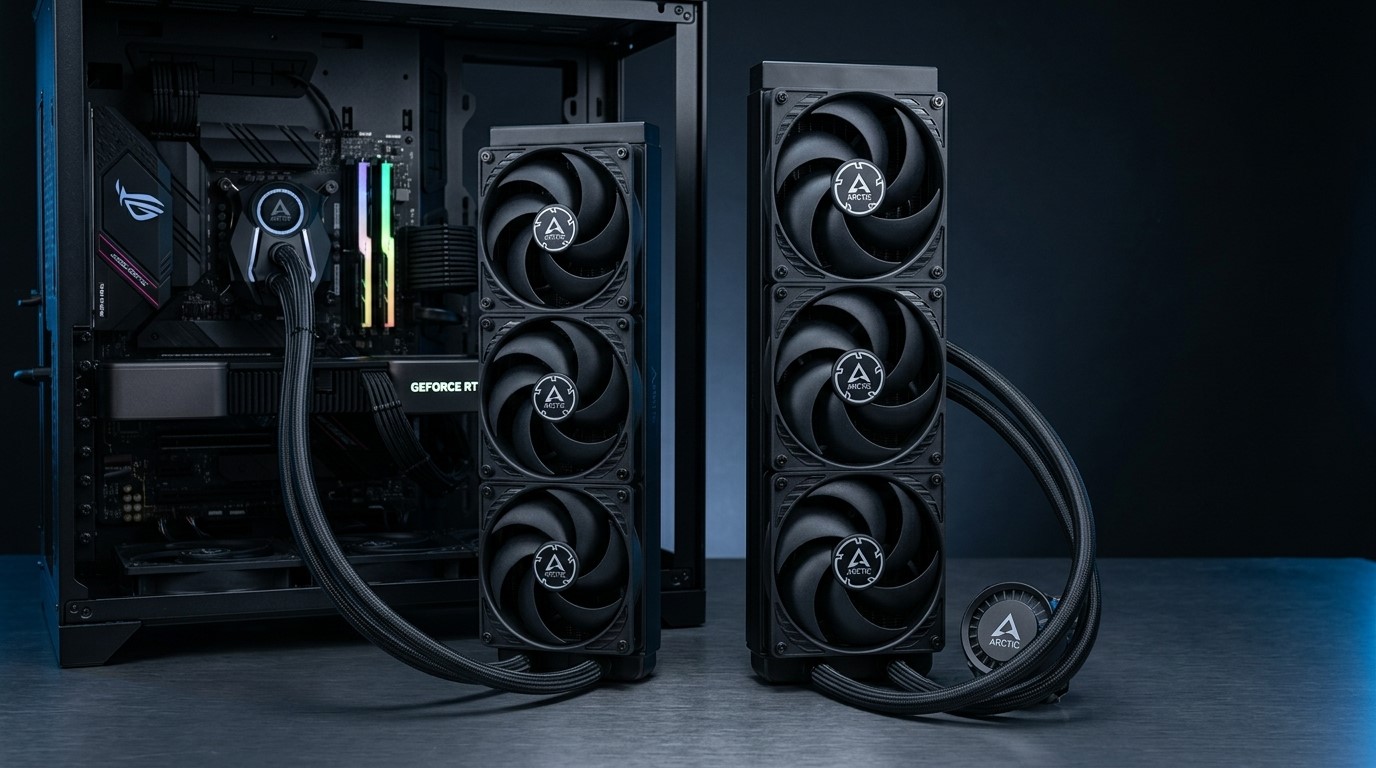
The Arctic Liquid Freezer III Pro 360 vs 420 comparison comes down to a classic question for high-performance PC builders: how much cooling capacity do you actually need? Both coolers belong to Arctic’s Liquid Freezer III Pro generation and are designed for demanding modern CPUs, but they take different approaches to achieving their thermal performance. The Pro 360 uses three 120mm P12 Pro fans on a 360mm-class radiator, while the Pro 420 moves to three larger 140mm P14 Pro fans and a substantially larger radiator. Arctic also equips both models with a PWM-controlled pump, a VRM cooling fan, a copper micro-skived cold plate, and a six-year warranty.
The 420 therefore has more radiator area and greater airflow potential, but its physical size can make installation considerably more demanding. The 360 is easier to fit in many performance-oriented cases while still offering exceptional thermal performance. Independent testing has shown the 420 can outperform strong 360mm AIOs under heavy CPU loads, although the difference becomes much smaller at moderate power levels.
This guide compares the two models across design, cooling, acoustics, compatibility, installation, performance, value, and long-term ownership so you can decide which configuration fits your PC.
Feature-by-Feature Comparison Table
Before choosing between these two Arctic AIOs, it helps to look beyond the simple 360mm-versus-420mm distinction. The radiator dimensions, fan configuration, pump, tubing, weight, and airflow characteristics all affect how each cooler behaves inside a real PC.
| Feature | Arctic Liquid Freezer III Pro 360 | Arctic Liquid Freezer III Pro 420 |
|---|---|---|
| Radiator class | 360mm | 420mm |
| Radiator dimensions | 398 × 120 × 38mm | 458 × 138 × 38mm |
| Radiator material | Aluminum | Aluminum |
| Radiator fans | 3 × P12 Pro | 3 × P14 Pro |
| Fan size | 120mm | 140mm |
| Fan speed | 600–3000 RPM | 400–2500 RPM |
| Maximum airflow | 77 CFM per fan | 110 CFM per fan |
| Static pressure | Up to 6.9 mmH₂O | Up to 5.2 mmH₂O |
| Pump speed | 800–2800 RPM | 800–2800 RPM |
| VRM fan | Yes | Yes |
| VRM fan speed | 400–2500 RPM | 400–2500 RPM |
| Cold plate | Copper micro-skived fins | Copper micro-skived fins |
| Tube length | 450mm | 500mm |
| Included thermal compound | MX-6 | MX-6 |
| CPU support | AM4, AM5, LGA1700, LGA1851 | AM4, AM5, LGA1700, LGA1851 |
| Approx. cooler weight | 2020g | 2358g |
| Warranty | 6 years | 6 years |
| Best suited for | High-performance builds with broader case compatibility | Maximum cooling and high-power CPUs |
Specifications are based on Arctic’s published specification sheets.
The most important difference is not the pump or cold plate. Both models use the same basic Pro platform. The major change is the radiator and fan system. The 360 uses three high-speed 120mm P12 Pro fans capable of reaching 3000 RPM, whereas the 420 uses three larger P14 Pro fans that operate up to 2500 RPM while producing substantially higher maximum airflow per fan.
Quick Highlights Table
If you want the differences at a glance, this table summarizes where each cooler makes the most sense.
| Category | Liquid Freezer III Pro 360 | Liquid Freezer III Pro 420 |
|---|---|---|
| Cooling capacity | Excellent | Exceptional |
| Heavy sustained workloads | Excellent | Excellent+ |
| High-power CPUs | Very capable | Better suited |
| Moderate workloads | More than enough | More than enough |
| Case compatibility | Easier | More restrictive |
| Radiator size | Large | Very large |
| Fan speed | Higher | Lower |
| Maximum airflow | Lower | Higher |
| Noise potential | Can become loud | Can become loud at maximum |
| Installation practicality | Easier | More demanding |
| Large-case builds | Excellent | Ideal |
| Compact performance cases | Better choice | Often unsuitable |
| Enthusiast overclocking | Excellent | Better thermal headroom |
| Overall flexibility | Higher | Lower due to size |
The central trade-off is straightforward: the Pro 420 prioritizes maximum thermal capacity, while the Pro 360 provides a better balance between cooling potential and installation flexibility.
Key Takeaways

Both coolers are designed for users who want substantially more cooling capability than a basic air cooler or entry-level AIO can provide. The decision is therefore less about whether either cooler is capable and more about your CPU, case, workload, and noise expectations.
- The Pro 420 has the larger thermal capacity. Its 420mm radiator and three P14 Pro fans give it more cooling surface area and airflow potential.
- The Pro 360 is easier to accommodate. A 360mm radiator is supported by considerably more PC cases than a 420mm radiator.
- Both use the same core Pro cooling architecture. The pump operates from 800–2800 RPM, and both use a copper micro-skived cold plate and dedicated VRM fan.
- The 420 is particularly attractive for high sustained CPU power. Testing with a Ryzen 9 9950X showed the 420 achieving extremely strong thermal results under demanding loads.
- The difference is smaller at moderate CPU power. In Tom’s Hardware testing, the 420’s advantage over the strongest 360mm result was less than 1°C at a 200W workload.
- The Pro 360’s P12 Pro fans are extremely high-speed. They can reach 3000 RPM, giving the smaller radiator substantial airflow and static-pressure capability.
- The 420’s P14 Pro fans move more air per fan. Arctic rates them at up to 110 CFM and 5.2 mmH₂O static pressure.
- Case compatibility is the biggest potential obstacle for the 420. A 458 × 138 × 38mm radiator requires substantial mounting space before fan thickness is even considered.
- Neither is designed specifically for silence at maximum speed. Independent testing recorded substantial noise when the 420 was allowed to run at full fan speed.
Pros & Cons
The Arctic Liquid Freezer III Pro 360 vs 420 decision becomes easier when the strengths and limitations of each model are considered separately.
Arctic Liquid Freezer III Pro 360
Pros
- Excellent high-end CPU cooling performance
- Three high-performance P12 Pro fans
- Up to 3000 RPM fan speed
- Strong static pressure
- 360mm format fits many performance cases
- Copper micro-skived cold plate
- Dedicated VRM cooling fan
- 450mm tubing
- MX-6 thermal compound included
- Six-year warranty
- Strong option for high-performance gaming PCs and workstations
Cons
- Smaller radiator than the 420
- Maximum fan speed can produce significant noise
- 120mm fan format requires higher RPM for maximum airflow
- Not quite as much thermal headroom as the 420 under extreme sustained loads
- The thick radiator should still be checked against motherboard and case clearance
Arctic Liquid Freezer III Pro 420
Pros
- Extremely high cooling capacity
- Larger 420mm radiator
- Three high-airflow 140mm P14 Pro fans
- Up to 110 CFM per radiator fan
- Lower maximum fan RPM than the 360
- 500mm tubing
- Dedicated VRM cooling fan
- Copper micro-skived cold plate
- Six-year warranty
- Excellent for high-power processors
- Strong performance under sustained workloads
Cons
- Requires a large compatible case
- Radiator measures 458mm long and 138mm wide
- Heavier than the Pro 360
- Installation can be more complicated
- Maximum fan speed can still be loud
- The additional cooling capacity may provide limited benefit for lower-power CPUs
Cooling Performance: 360 vs 420
Cooling performance is where the Pro 420 has the clearest theoretical advantage. Its radiator measures 458 × 138 × 38mm, compared with 398 × 120 × 38mm for the Pro 360. Both retain the same 38mm radiator thickness, so the 420’s advantage primarily comes from its larger frontal area.
That additional surface area gives the 420 more opportunity to transfer heat from the liquid into the surrounding air.
However, bigger does not automatically mean dramatically cooler in every workload.
At moderate CPU power, the difference between high-end 360mm and 420mm AIOs can become surprisingly small. Tom’s Hardware measured the Liquid Freezer III Pro 420 at 73.6°C in a roughly 200W Cinebench R23 workload on a Ryzen 9 9950X. That was only 0.9°C better than the best 360mm result in its comparison. At 150W, the difference was similarly around 0.9°C.
This illustrates an important point: once a 360mm cooler is already very capable, adding radiator area does not necessarily create a huge temperature reduction.
The difference becomes more meaningful when the CPU continuously generates substantial heat.
In heavier testing, the Pro 420 demonstrated impressive thermal capacity, handling more than 260W under an aggressive PBO configuration in Tom’s Hardware’s testing. With additional GPU heat introduced into the case, it still maintained a strong result.
For users running processors at high sustained power, that additional thermal headroom can be valuable.
Fan Design and Airflow
The fan difference between the two models is substantial.
The Pro 360 uses three P12 Pro fans rated from 600 to 3000 RPM. Each fan is rated for up to 77 CFM airflow and up to 6.9 mmH₂O static pressure.
The Pro 420 uses three P14 Pro fans. These operate from 400 to 2500 RPM and are rated for up to 110 CFM airflow with up to 5.2 mmH₂O static pressure.
In practical terms, the Pro 360 relies on very high-speed 120mm fans, while the Pro 420 takes advantage of larger 140mm fans that can move considerably more air without needing the same maximum rotational speed.
This creates two different performance philosophies.
The 360’s P12 Pro fans offer impressive pressure characteristics and extremely high rotational capability. That is useful when pushing air through a relatively dense radiator.
The 420’s P14 Pro fans have a larger blade area and can move significantly more air. Combined with the larger radiator, this gives the 420 a powerful airflow system.
Neither configuration should be considered automatically silent. Tom’s Hardware measured the Pro 420 at 52.7 dBA at maximum volume and 42.4 dBA under a 150W CPU workload in its testing.
For a quiet PC, sensible fan curves are therefore important.
Radiator Size and Case Compatibility
This is arguably the most important practical difference.
The Pro 360 radiator measures 398mm long, 120mm wide, and 38mm thick. The Pro 420 radiator measures 458mm long, 138mm wide, and 38mm thick.
Remember that these measurements describe the radiator itself. Fans add additional thickness, while the case mounting structure and surrounding hardware also require clearance.
A 360mm radiator is common in high-end ATX and full-tower cases. A 420mm radiator is much more demanding because the case must support 140mm radiator mounting in the correct location.
The Pro 420 is therefore a cooler you should buy after checking case compatibility, rather than assuming it will fit because your case supports a large radiator.
The Pro 360 is considerably easier to integrate into mainstream high-performance systems.
For a new build using a very large full-tower chassis, the 420 becomes more attractive. For a typical enthusiast ATX case, the 360 is often the safer choice.
Pump, Cold Plate and VRM Cooling
The core pump and cold-plate technology is remarkably similar between the two versions.
Both use a pump rated from 800 to 2800 RPM and a copper cold plate featuring micro-skived fins. Both also include Arctic’s integrated VRM fan.
That means you are not choosing between a basic cooling platform and a premium one.
Instead, the Pro 360 and Pro 420 share the same fundamental design philosophy, with the primary difference being the radiator and fan configuration.
The integrated VRM fan is an interesting feature because it provides airflow around the CPU socket area. This can be useful in high-performance systems where CPU power consumption and motherboard VRM load are substantial.
The pump also uses PWM control, allowing motherboard software or BIOS fan-control settings to adjust operation according to CPU temperature or system requirements.
Installation and Build Experience
The Pro 360 has an advantage in practical installation simply because the 360mm format is easier to accommodate.
The Pro 420’s physical dimensions make radiator placement more restrictive. A 458mm-long radiator can eliminate mounting positions that would be perfectly suitable for a 360mm unit.
The tubing is also longer on the 420, measuring 500mm compared with 450mm on the 360.
Longer tubing can help when installing the larger radiator farther from the CPU socket, particularly in spacious cases.
Both models support modern Intel LGA1700 and LGA1851 platforms as well as AMD AM4 and AM5.
One consideration for Intel builders is the mounting system. Tom’s Hardware notes that Arctic’s current-generation AIOs require the anti-bending frame for Intel systems, adding another installation consideration.
Overall, neither cooler should be selected without checking the exact motherboard socket, case radiator support, RAM clearance, and preferred radiator position.
Noise and Acoustics
Noise is an interesting area because both coolers can be quiet when their fans are operating at moderate speeds but become considerably louder when pushed toward maximum RPM.
The Pro 360’s P12 Pro fans can reach 3000 RPM. That gives the cooler considerable performance potential but also means there is a lot of fan-speed headroom to manage.
The Pro 420’s P14 Pro fans top out at 2500 RPM. Their larger diameter allows them to move more air without needing the same rotational speed.
Yet larger does not automatically mean quiet. In Tom’s Hardware’s testing, the Pro 420 reached 52.7 dBA at full speed. At a 150W CPU load, it measured 42.4 dBA.
For most users, there is little reason to run either cooler at maximum speed continuously.
A properly tuned fan curve can allow the radiator fans to remain at lower speeds during gaming and everyday workloads, then ramp up when the CPU is genuinely under heavy sustained load.
Performance for Gaming
For gaming, both coolers are more than capable for many CPU configurations.
Modern games typically do not maintain the same sustained CPU power consumption as lengthy rendering, encoding, compilation, or Cinebench workloads. Consequently, the Pro 360 can provide plenty of thermal capacity for a high-end gaming processor.
The Pro 420 becomes more interesting if you are combining a very high-power CPU with long gaming sessions, heavy background workloads, aggressive power limits, or a heavily tuned processor.
The extra radiator capacity can also help maintain lower temperatures without requiring the fans to operate at their maximum speed.
However, if your CPU rarely approaches its power limit, the practical temperature difference may be modest. The testing described above demonstrates that the advantage of the 420 can shrink considerably around the 150–200W range.
Performance for Productivity and Workstations
Productivity workloads make a stronger case for the Pro 420.
Video rendering, 3D rendering, software compilation, scientific workloads, CPU encoding, and long-duration benchmark runs can keep a processor under sustained load for much longer than typical gaming.
This is exactly where radiator capacity matters.
A larger radiator can absorb and dissipate heat continuously, reducing the thermal pressure on the CPU cooling system.
The Pro 360 remains highly capable, but the 420 provides more overhead for users who routinely push high CPU power for extended periods.
For a workstation based around a high-core-count processor, the 420 therefore has a practical advantage if your chassis can accommodate it.
CPU Compatibility
Both coolers support modern enthusiast CPU sockets, including AMD AM4 and AM5 and Intel LGA1700 and LGA1851.
This makes both models suitable for a wide range of modern gaming and workstation systems.
The more important compatibility question is the processor’s thermal and power characteristics.
A midrange processor does not necessarily benefit enough from a 420mm AIO to justify the additional physical requirements.
A high-end processor operating at high sustained power is a different situation.
Therefore, CPU compatibility should be divided into two questions:
- Does the mounting hardware support the CPU socket?
- Does the CPU actually benefit from the additional cooling capacity?
The first is a technical compatibility issue. The second is a system-design decision.
Value and Long-Term Ownership
Arctic has traditionally positioned its Liquid Freezer products around strong performance relative to price, and the Pro 360 and 420 continue that approach.
The 420 has the larger radiator and fan system, but its usefulness depends heavily on whether your system can take advantage of that additional capacity.
The Pro 360 can therefore deliver stronger overall flexibility for builders who want high-end cooling without moving to an unusually large chassis.
Both models carry a six-year warranty according to Arctic’s specifications.
That long warranty period is particularly useful for a liquid cooling product because AIO longevity is an important part of ownership.
The included MX-6 thermal compound is another useful addition, reducing the need to purchase separate thermal paste during installation.
Which One Should You Choose for a High-End CPU?
If you are building around a high-end CPU that frequently operates at elevated power levels, the Pro 420 deserves serious consideration.
Its larger radiator provides greater cooling capacity, and its P14 Pro fans offer substantially higher rated airflow than the P12 Pro fans used on the 360.
This is particularly relevant for processors that are allowed to run with high power limits or tuned for sustained performance.
The Pro 360 remains a strong choice when the CPU is powerful but the case does not support a 420mm radiator.
It can also be the more sensible choice when the difference between the two models is small in your region but the larger cooler would force you to compromise on case selection or radiator placement.
Which One Should You Choose for a Gaming PC?
For most gaming-focused high-end builds, the Pro 360 provides an excellent balance.
It offers substantial cooling capacity while fitting into more cases.
If your gaming PC uses a powerful CPU and you also perform CPU-heavy workloads, the Pro 420 can make sense if your case has sufficient radiator clearance.
The key is not to buy the largest AIO simply because it is larger.
A cooler should be selected as part of the complete system. Case airflow, CPU power limits, ambient temperature, GPU heat output, and fan curves all affect real-world results.
Buying Recommendations
Choose the Arctic Liquid Freezer III Pro 360 if:
- Your case supports 360mm radiators but not 420mm models.
- You want high-end cooling without an oversized radiator.
- You are building a high-performance gaming PC.
- Your CPU is powerful but does not constantly consume extreme power.
- You prefer easier case compatibility.
- You want P12 Pro fans with very high static pressure and up to 3000 RPM.
- You want strong performance while keeping more case options available.
Choose the Arctic Liquid Freezer III Pro 420 if:
- Your case officially supports a 420mm radiator.
- You use a high-power enthusiast CPU.
- You perform long rendering or CPU-heavy workloads.
- You want maximum thermal headroom.
- You are comfortable with a larger and heavier cooling system.
- You have a large ATX or full-tower case.
- You want the airflow potential of three 140mm P14 Pro fans.
Check These Things Before Buying
Before ordering either model, verify:
- CPU socket compatibility
- Case radiator compatibility
- Radiator thickness clearance
- Fan clearance
- RAM clearance
- Motherboard heatsink clearance
- GPU position
- Preferred radiator mounting position
- Tubing routing
- Front versus top radiator support
This is particularly important with the Pro 420 because its 458 × 138 × 38mm radiator is substantially larger than the Pro 360’s 398 × 120 × 38mm radiator.
Final Verdict
The Arctic Liquid Freezer III Pro 360 vs 420 comparison does not produce a simple winner because the two coolers target slightly different system requirements.
The Liquid Freezer III Pro 420 is the higher-capacity solution. Its larger radiator and three 140mm P14 Pro fans give it more thermal headroom, particularly when a high-end CPU is operating under sustained heavy loads. Independent testing has demonstrated extremely strong results from the 420, including leading performance under demanding Ryzen 9 9950X workloads.
The Liquid Freezer III Pro 360, however, offers an easier path to high-end cooling because its 360mm format fits a broader range of cases. Its P12 Pro fans can reach 3000 RPM and provide high static pressure, while the cooler retains the same basic pump, cold-plate, VRM fan, platform support, and six-year warranty characteristics.
At moderate CPU power levels, the performance gap can also be relatively small. Testing has shown the 420’s advantage shrinking to around 1°C against the best 360mm result at 150–200W.
That means your choice should primarily depend on CPU power, workload, case compatibility, and desired thermal headroom.
If your case comfortably supports a 420mm radiator and you want maximum cooling capacity, the Pro 420 provides the larger thermal platform.
If you want exceptional cooling in a more widely supported format, the Pro 360 is the more flexible option.
FAQ
Q1: Is the Arctic Liquid Freezer III Pro 420 better than the 360?
Ans: The Pro 420 has greater cooling capacity because it uses a larger 420mm radiator and three 140mm P14 Pro fans. However, the performance advantage varies with CPU power. At moderate workloads, the difference can be relatively small, while sustained high-power workloads can make the 420’s additional radiator area more useful.
Q2: Does the Liquid Freezer III Pro 360 use the same pump as the 420?
Ans: Yes. Both models use a PWM-controlled pump rated from 800 to 2800 RPM and use a copper cold plate with micro-skived fins. Both also feature an integrated VRM fan.
Q3: Which is quieter, the Liquid Freezer III Pro 360 or 420?
Ans: Neither should automatically be considered silent. The Pro 360’s P12 Pro fans can reach 3000 RPM, while the Pro 420’s P14 Pro fans reach 2500 RPM. The larger 420 fans can move more air at lower rotational speed, but maximum-speed operation can still become loud. Tom’s Hardware measured the Pro 420 at 52.7 dBA at maximum volume in its testing.
Q4: Will a 420mm AIO fit in any case that supports a 360mm radiator?
Ans: No. A case supporting a 360mm radiator does not necessarily support a 420mm radiator. The Pro 420 radiator measures 458 × 138 × 38mm, compared with 398 × 120 × 38mm for the Pro 360. You should check your case manufacturer’s exact radiator and fan compatibility before purchasing.
Q5: Which Arctic Liquid Freezer III Pro is better for a Ryzen 9 processor?
Ans: Both can be suitable for high-end Ryzen 9 processors. The Pro 420 provides additional thermal capacity and is particularly attractive when the processor operates at high sustained power. The Pro 360 can still provide excellent cooling when case compatibility or system size makes the larger 420 impractical.
Q6: Does the Liquid Freezer III Pro 420 have better cooling than the Pro 360 at every power level?
Ans: No. Larger radiator capacity does not guarantee a large temperature difference at every workload. Testing has shown that the gap between the 420 and top-performing 360mm AIOs can become quite small at 150–200W. The advantage becomes more relevant as sustained heat output increases.
Q7: Which should I buy, the Liquid Freezer III Pro 360 or 420?
Ans: Choose based on your complete system rather than radiator size alone. The Pro 360 is well suited to high-performance PCs where case compatibility and flexibility matter. The Pro 420 is designed for builders who have sufficient space and want additional thermal capacity for demanding, sustained CPU workloads.
Short Conclusion
The Arctic Liquid Freezer III Pro 360 vs 420 comparison ultimately comes down to balance versus maximum capacity. The Pro 360 delivers exceptional high-end cooling in a more practical 360mm format, while the Pro 420 adds a larger radiator and 140mm fans for greater thermal headroom. For extreme sustained CPU workloads and large compatible cases, the 420 offers additional cooling potential. For most performance builds where compatibility and flexibility matter, the 360 remains a highly capable option.