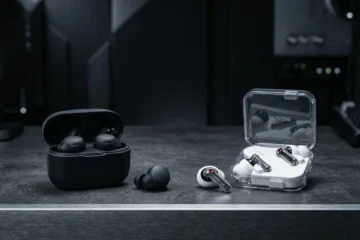
Choosing the right budget wireless earbuds can be surprisingly difficult, especially when two models from the same brand target different types of listeners. In this TOZO NC9 vs A1 comparison, both earbuds offer the convenience of true wireless listening, compact charging cases, and compatibility with everyday Bluetooth devices. However, their designs, features, and intended uses make them suitable for different priorities.
The TOZO NC9 is designed for listeners who want more control over their listening environment. Its main attractions include hybrid active noise cancellation (ANC), transparency mode, environmental noise reduction for calls, and a charging case that supports wireless charging. The TOZO A1, meanwhile, focuses on a lightweight, compact design, straightforward operation, and affordable everyday listening.
Whether you enjoy music during your commute, attend online classes, make phone calls, or simply want comfortable earbuds for daily use, understanding these differences can help you make a better purchase. This guide compares their features, sound characteristics, battery performance, comfort, durability, and overall value so you can decide which TOZO earbuds deserve your money.
Feature-by-Feature Comparison Table
The following table highlights the main differences between the TOZO NC9 and the original TOZO A1. Specifications can vary between product revisions and regional listings, so confirm the details of the exact model you intend to purchase.
| Feature | TOZO NC9 | TOZO A1 |
|---|---|---|
| Product category | True wireless earbuds | True wireless earbuds |
| Main focus | Noise cancellation and versatility | Lightweight, everyday listening |
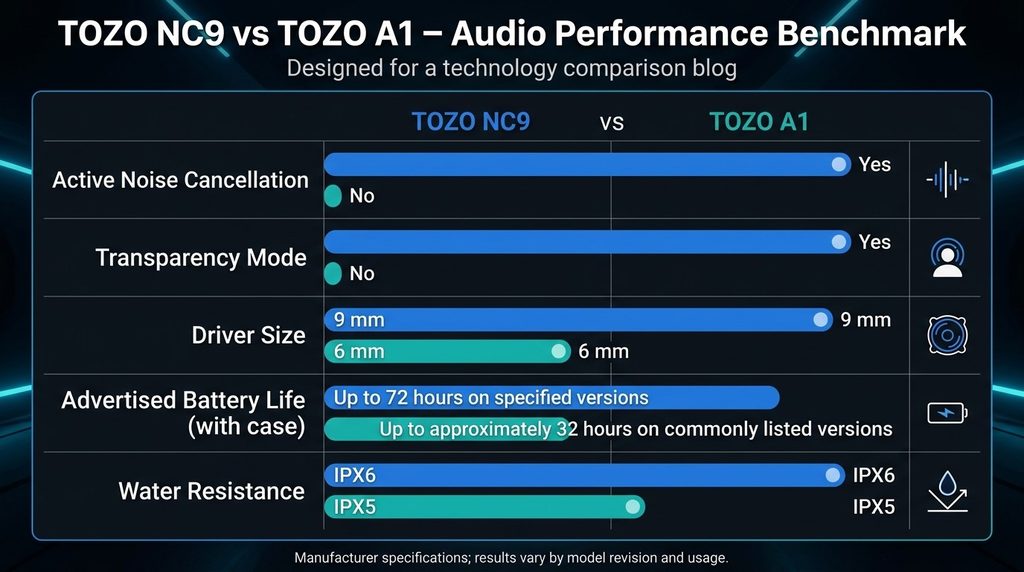
| Driver size | Approximately 9 mm | 6 mm |
| Active noise cancellation | Yes, hybrid ANC | No |
| Transparency mode | Yes | No dedicated transparency mode |
| Passive noise isolation | Yes, with a suitable ear-tip seal | Yes, with a suitable ear-tip seal |
| Call noise reduction | Dual-microphone ENC | Basic microphone functionality |
| Bluetooth | Bluetooth 5.3 on the listed NC9 version | Bluetooth 5.3 on commonly listed A1 versions |
| Audio codecs | AAC and SBC on the listed NC9 version | SBC support; check the exact listing for codec details |
| Single-charge battery life | Up to approximately 10–18 hours, depending on version and settings | Up to approximately 6–8 hours, depending on version and settings |
| Total battery with case | Advertised figures vary by version; some listings claim up to 72 hours | Commonly advertised at up to approximately 32 hours |
| Wireless charging | Supported on the listed NC9 version | Not a standard feature |
| USB-C charging | Yes | Yes |
| Water resistance | IPX6 on the official NC9 specification listed here | IPX5 on commonly listed A1 specifications |
| Fit | In-ear design with silicone tips | Compact, lightweight in-ear design |
| Companion app | Supported on compatible versions | Availability depends on model and app compatibility |
| Best suited for | Commuting, work, travel, and noisy surroundings | Casual listening, walking, studying, and everyday use |
The NC9’s official product information lists hybrid ANC, transparency mode, Bluetooth 5.3, wireless charging, and IPX6 water resistance. Its published battery figures differ across product revisions and marketing pages, so the precise model matters. The A1 is the simpler option, prioritizing a small form factor rather than active noise cancellation.
Quick Highlights Table
If you want a quick answer before reading the full comparison, these highlights explain where each model makes the most sense.
| Category | Better Choice | Why |
|---|---|---|
| Active noise cancellation | TOZO NC9 | Reduces suitable background noise electronically |
| Lightweight design | TOZO A1 | Compact earbuds designed for a discreet fit |
| Commuting | TOZO NC9 | ANC helps reduce consistent environmental noise |
| Basic everyday listening | TOZO A1 | Simple functionality without paying for extra features |
| Transparency listening | TOZO NC9 | Helps you hear surrounding sounds without removing the earbuds |
| Charging convenience | TOZO NC9 | Supports wireless charging on the specified version |
| Compact portability | TOZO A1 | Small earbuds are easy to carry and wear |
| Calls in noisy environments | TOZO NC9 | Dedicated call-noise reduction can help with background distractions |
| Water and sweat protection | TOZO NC9 | The listed IPX6 rating offers stronger water-jet protection than IPX5 |
| Budget-focused buying | TOZO A1 | A practical option if ANC and wireless charging are unnecessary |
These are feature-based recommendations rather than claims that one model wins every real-world test. Fit, firmware, volume, environmental noise, and the exact product revision can affect your experience.
Key Takeaways
The biggest difference in the TOZO NC9 vs A1 comparison is that the NC9 offers a more feature-rich listening experience, while the A1 keeps things simple and lightweight. Your best choice depends on how often you encounter background noise and which features you will actually use.
- Choose the TOZO NC9 for noise cancellation. Its hybrid ANC can reduce consistent sounds from fans, air conditioners, buses, and other surroundings.
- Choose the TOZO A1 for simplicity. Its compact design makes it a practical option for casual music listening and everyday activities.
- Consider the NC9 for commuting. ANC and transparency mode are useful when switching between focused listening and awareness of your surroundings.
- Do not judge sound quality by driver size alone. The NC9 has a larger driver, but tuning, fit, ear tips, and recording quality also affect the final sound.
- Compare battery claims carefully. Playback time varies with volume, ANC settings, battery age, and product revision.
- Think about comfort before buying. The lighter A1 may suit people who dislike bulky earbuds, while the NC9’s fit may work better for listeners who prefer a more feature-rich in-ear design.
- Pay attention to water resistance. Neither model should automatically be treated as suitable for swimming, and water resistance does not guarantee protection against every type of liquid exposure.
Design and Comfort
Comfort is one of the most important factors when choosing wireless earbuds. Even earbuds with excellent specifications can become frustrating if they press against your ears or loosen during movement.
TOZO NC9 Design
The TOZO NC9 uses an in-ear design with silicone ear tips. These tips help create a seal inside the ear canal, which supports passive noise isolation and allows the active noise cancellation system to work more effectively.
The NC9 is a practical choice for people who regularly listen to music for extended periods, travel on public transportation, or work in shared environments. Its ear tips also allow users to experiment with different sizes to find a more secure fit.
However, its more substantial design may not suit everyone. People with smaller ears or those who dislike the sensation of an ear tip inside the ear canal should check the fit carefully.
TOZO A1 Design
The TOZO A1 takes a compact approach. Its lightweight construction is intended to make everyday listening comfortable without adding unnecessary bulk. This can be especially appealing to students, casual listeners, and people who want earbuds they can carry in a pocket or small bag.
The smaller design may also make the A1 feel less noticeable during routine activities. Nevertheless, comfort is subjective. A lightweight earbud can still fit poorly if its shape does not match your ears.
Comfort winner: The TOZO A1 has the advantage for buyers who prioritize compactness and low weight. The NC9 is more appealing if you want the combination of a sealed in-ear fit and additional listening features.
Sound Quality
Sound quality deserves careful attention because neither a larger driver nor a longer feature list guarantees better audio.
Bass Performance
The TOZO NC9’s approximately 9 mm dynamic driver gives it a larger driver platform than the A1’s 6 mm driver. This may contribute to a fuller presentation, but the actual bass response depends on the acoustic design and tuning.
With a good seal, the NC9 can deliver satisfying low frequencies for pop, hip-hop, electronic music, and action-heavy video content. Its noise cancellation can also make bass easier to appreciate in noisy surroundings because less environmental sound competes with the music.
The A1 is suitable for casual listening and everyday playlists. Its smaller driver does not automatically mean weak bass; ear-tip fit and sound tuning have a substantial influence on perceived low-frequency performance.
Vocals and Midrange
Vocals, podcasts, audiobooks, and dialogue depend heavily on midrange clarity. Both earbuds can serve these uses, although individual listeners may prefer one model’s tuning.
The NC9’s noise cancellation is useful when you want to concentrate on speech in a busy environment. The A1 can be perfectly adequate for listening at home, in a quiet classroom, or during a walk in a relatively calm area.
Remember that ANC reduces certain external noises; it does not automatically improve the intrinsic fidelity of a recording.
Treble and Detail
High frequencies help convey cymbals, vocal texture, and fine musical details. The A1’s compact size does not prevent it from reproducing treble, just as the NC9’s larger driver does not guarantee superior detail.
Your experience will depend on the frequency tuning, the quality of the source, and the seal around your ears. If you listen to acoustic music or detailed instrumental recordings, try both models if possible rather than relying on driver measurements alone.
Which Sounds Better?
The NC9 is the more versatile choice for people who frequently listen in noisy locations. Its ANC gives it a practical advantage when you need to hear music without raising the volume to compete with your surroundings.
The A1 remains a reasonable choice for everyday listening when you do not need noise cancellation. The most accurate way to compare their sound quality is through consistent listening tests using the same tracks, similar volume levels, and a secure fit.
Sound-quality verdict: The NC9 is the more capable all-around listening package, but the available specifications alone do not prove that it will sound better to every listener.
Active Noise Cancellation
Noise cancellation is the most significant feature separating these earbuds.
How the NC9’s ANC Works
The TOZO NC9 uses hybrid active noise cancellation to reduce certain external sounds. The system uses microphones and electronic processing to counter unwanted ambient noise.
It can be especially useful for relatively consistent sounds, including:
- Air-conditioning and ventilation.
- The low rumble of buses and trains.
- Background noise in an office.
- Some engine noise during travel.
- General environmental hum in busy indoor spaces.
ANC is not complete silence. Sudden voices, nearby conversations, sharp sounds, and changing noises may remain audible. Results also depend on how well the ear tips seal your ear canals.
The NC9 additionally offers a transparency mode, which allows more outside sound to reach your ears. This can be useful when you need to hear announcements or speak with someone without removing your earbuds.
Does the TOZO A1 Have ANC?
The original TOZO A1 does not offer dedicated active noise cancellation. Instead, it relies primarily on the physical isolation provided by its fit.
A suitable in-ear seal can reduce some external noise, but passive isolation is different from electronic noise cancellation. It is generally less effective against certain low-frequency environmental sounds.
This distinction matters if you regularly travel on crowded public transportation, work near noisy machinery, or study in a busy household.
Noise-cancellation winner: TOZO NC9. If ANC is one of your main reasons for buying wireless earbuds, the A1 is not an equivalent alternative.
Battery Life and Charging
Battery life determines how often you need to return your earbuds to their charging case. It matters particularly for commuters, frequent travelers, and people who listen throughout the workday.
TOZO NC9 Battery
TOZO advertises substantial combined playback time for the NC9, with some official specifications listing up to 72 hours under particular conditions. However, different NC9 revisions and product pages report different figures.
The earbuds’ individual playback time will also depend on whether ANC is enabled, your listening volume, and other operating conditions. Using ANC typically reduces the time available between charges compared with listening without it.
One useful advantage is wireless charging on the specified NC9 version. You can place its compatible case on a suitable wireless charging pad instead of always connecting a cable.
USB-C charging is also available, giving you a familiar wired charging option.
TOZO A1 Battery
The original A1 is commonly advertised with approximately 6–8 hours of playback from the earbuds and up to around 32 hours when the charging case is included. Exact figures depend on the particular listing and testing conditions.
For someone who listens for a few hours each day, this can be sufficient. You can return the earbuds to their case between listening sessions rather than keeping them in use continuously.
The A1 also supports USB-C charging on commonly listed versions, but it does not offer the same standard wireless charging convenience as the specified NC9 model.
Which Battery Is Better?
The NC9 is the stronger choice if long listening sessions, additional case capacity, and wireless charging matter to you. The A1 should still be suitable for everyday use if you charge it regularly and do not need its earbuds to remain active for exceptionally long sessions.
Before purchasing, verify the stated playback time for the exact model and revision. Manufacturer maximums are not guaranteed results for every user.
Battery and charging winner: TOZO NC9, particularly if its longer advertised endurance and wireless charging match your needs.
Microphone and Call Quality
Wireless earbuds are increasingly used for work calls, online classes, voice messages, and video meetings. Microphone performance therefore deserves attention alongside music playback.
TOZO NC9 Call Performance
The NC9 includes a dual-microphone environmental noise cancellation system for calls. This processing is intended to reduce background noise picked up during conversations.
It can help when you are speaking from a room with a fan running or another location with moderate background noise. However, call noise reduction does not guarantee studio-quality voice reproduction.
Wind, loud traffic, crowded public areas, and strong background conversations can still affect intelligibility. Your phone, calling application, Bluetooth connection, and microphone placement can also influence the result.
TOZO A1 Call Performance
The A1 provides basic microphone functionality for calls and voice communication. It is suitable for ordinary conversations in relatively quiet places.
If you mostly take calls at home or use your earbuds for occasional online classes, the A1 may provide everything you need. If you frequently take calls while walking outdoors or working in a noisy environment, the NC9’s additional call-noise processing is more attractive.
Microphone winner: TOZO NC9 on features. Real-world voice clarity should still be evaluated through actual calls, because microphone specifications alone do not establish which model sounds clearer in every situation.
Bluetooth and Everyday Connectivity
Both models are true wireless earbuds designed to connect to compatible Bluetooth devices, including smartphones, tablets, and computers.
The commonly listed versions use Bluetooth 5.3, although buyers should verify the specification on the exact packaging or listing. Bluetooth version alone does not establish superior sound quality, lower latency, or a stronger connection in every environment.
Both earbuds are intended for routine listening, including music streaming, podcasts, video playback, and calls. Their connection performance can vary with distance, obstacles, interference, and the Bluetooth hardware in the connected device.
For gaming, neither should be selected solely because of its Bluetooth version. Wireless audio latency can affect competitive gaming, particularly when sound cues must match fast on-screen action.
If you frequently switch between a laptop and a phone, check whether your exact model supports multipoint connectivity. Do not assume that two devices can remain connected simultaneously simply because the earbuds support Bluetooth.
Connectivity verdict: Both are suitable for common Bluetooth listening tasks. The NC9’s main advantage is its broader listening feature set rather than an automatic connectivity victory.
Water Resistance and Durability
Water resistance is important if you exercise, walk outdoors, or use your earbuds in warm weather.
The listed NC9 version carries an IPX6 rating, while commonly listed original A1 specifications identify IPX5. Both ratings indicate protection against water exposure under specified test conditions, with IPX6 designed to withstand more powerful water jets than IPX5.
Neither rating means the earbuds are waterproof in every situation. They should not be submerged, used for swimming, or exposed unnecessarily to hot water. Water resistance can also decline as products age or become damaged.
For workouts, both models may be suitable when used within their rated limits. The NC9 has an advantage if stronger water-jet resistance is a priority, but the A1 can still be a sensible option for ordinary exercise and daily wear.
After a sweaty workout, wipe your earbuds dry before placing them in the charging case. Keep the charging contacts clean, and never charge wet earbuds.
Durability winner: TOZO NC9 on the listed IP rating. Neither model should be treated as indestructible, and careful maintenance remains essential.
TOZO NC9 vs A1: Pros & Cons
Pros & Cons
When comparing TOZO NC9 vs A1, the right choice depends on whether you prefer extra functionality or a compact, straightforward listening experience. Here are the main advantages and disadvantages of each model.
TOZO NC9 Pros & Cons
Pros
- Hybrid active noise cancellation helps reduce distracting background sounds.
- Transparency mode makes it easier to hear surrounding sounds when needed.
- Dual-microphone call-noise reduction adds useful functionality for conversations.
- Larger dynamic drivers provide a different acoustic platform for music playback.
- Wireless charging is available on the specified NC9 version.
- USB-C charging offers convenient everyday connectivity.
- The listed IPX6 rating provides protection against powerful water jets under specified test conditions.
- Multiple ear-tip sizes help users find a suitable fit.
Cons
- Its in-ear design may feel bulky to people who prefer very small earbuds.
- Using ANC can reduce battery life.
- The additional features may be unnecessary for people who listen primarily in quiet environments.
- Microphone processing cannot eliminate every type of background noise.
- Specifications and advertised battery figures vary across NC9 revisions, making it important to verify the exact model.
TOZO A1 Pros & Cons
Pros
- Compact, lightweight construction is appealing for everyday listening.
- Straightforward operation suits people who do not need advanced features.
- Bluetooth connectivity supports common listening devices.
- USB-C charging is available on commonly listed versions.
- Passive isolation can reduce some surrounding noise when the fit is good.
- Its simpler feature set makes it a reasonable option for budget-conscious listeners.
Cons
- No dedicated active noise cancellation on the original A1.
- No dedicated transparency mode.
- Basic microphone functionality may be less suitable for noisy calling environments.
- No standard wireless charging feature.
- Its smaller driver does not guarantee the same bass presentation or overall tuning as the NC9.
- The more basic feature set may feel limiting for frequent commuters and people who work in noisy environments.
Overall, the NC9 offers more functionality, while the A1 makes sense when simplicity and compactness matter more than advanced listening controls.
Buying Recommendations
The best way to choose between the TOZO NC9 and A1 is to consider where you listen, how often you use your earbuds, and which features would genuinely improve your routine.
1. Best for Commuting: TOZO NC9
If you travel by bus, train, or other public transportation, the NC9 is the more practical option. Its active noise cancellation can reduce consistent background rumble, making music and podcasts easier to hear at moderate listening levels.
Its transparency mode is also useful when you need to hear announcements or communicate with people nearby. Nevertheless, remain aware of traffic and other hazards, especially when walking outdoors.
2. Best for Students: Depends on Your Environment
For studying in a quiet bedroom, library, or classroom, the A1 can provide a simple and affordable listening solution. Its compact design is convenient for carrying between classes.
However, if you study in a noisy household, share a dormitory, or regularly work in busy public spaces, the NC9 may be worth the extra cost because ANC can help you concentrate.
3. Best for Office Work: TOZO NC9
The NC9 is the stronger option for people who listen to music while working, attend online meetings, or need to reduce distractions in a shared office.
Its ANC, transparency mode, and call-noise reduction provide flexibility across different tasks. However, if your primary concern is professional voice quality, consider testing the microphone or comparing independent call samples before purchasing.
4. Best for Casual Music Listening: TOZO A1
If you mainly listen to music at home, watch videos, or enjoy podcasts during quiet walks, the A1 may be sufficient. You avoid paying for noise-cancellation features that you might rarely use.
It is also a sensible choice if you prefer compact earbuds and do not need wireless charging.
5. Best for Travel: TOZO NC9
Long journeys often involve engine noise, conversations, and crowded surroundings. The NC9’s ANC and potentially longer advertised battery endurance make it the better-equipped travel companion.
Before a long trip, fully charge the earbuds and case, check your exact model’s battery specifications, and download any music or podcasts you want to play offline.
6. Best for Workouts: Compare Fit First
Both models can be considered for ordinary workouts within their water-resistance limits. The NC9 has the higher listed water-protection rating, while the A1’s compact form may appeal to people who prefer lightweight earbuds.
The most important factor is a secure fit. Earbuds that loosen while running or exercising can become inconvenient regardless of their technical specifications.
7. Best for Budget-Conscious Buyers: TOZO A1
If your priority is affordable wireless audio and you do not need ANC, transparency mode, or wireless charging, the A1 is worth considering.
However, compare the actual prices before deciding. Discounts on the NC9 can sometimes narrow the price difference, potentially making its additional features more attractive.
Final Verdict
The TOZO NC9 is the better all-around choice for users who want more features, particularly active noise cancellation, transparency mode, additional call-noise processing, and wireless charging on the specified version. It is better suited to commuting, travel, shared workspaces, and listening in environments where background noise can be distracting.
The TOZO A1 is the better fit for straightforward everyday listening. Its compact design and simpler feature set make it appealing to students, casual music listeners, and people who do not need electronic noise cancellation.
Neither model is automatically the best choice for everyone. The NC9 offers more functionality, but its benefits matter most when you actually use those features. The A1 can be the more sensible purchase if your listening habits are simple and your surroundings are relatively quiet.
Before ordering, confirm the exact model revision, current price, advertised playback time, water-resistance rating, and included accessories.
My recommendation is straightforward: choose the TOZO NC9 if you value ANC and versatility. Choose the TOZO A1 if you want compact, uncomplicated wireless earbuds for everyday use.
FAQs about TOZO NC9 and A1
Q1: Which is better, TOZO NC9 or TOZO A1?
Ans: The TOZO NC9 is generally the better choice for people who want active noise cancellation, transparency mode, additional call-noise processing, and wireless charging. The TOZO A1 is more suitable for basic listening, compact portability, and buyers who do not need advanced features. Your budget and listening environment should determine which one you choose.
Q2: Does the TOZO A1 have active noise cancellation?
Ans: No. The original TOZO A1 does not have dedicated active noise cancellation. It relies primarily on passive isolation from its fit and ear tips. The TOZO NC9 offers hybrid ANC, making it the better option for reducing certain background noises during travel, studying, or office work.
Q3: Which earbuds have better sound quality, TOZO NC9 or A1?
Ans: The NC9 has a larger listed dynamic driver and provides ANC, which can make listening more comfortable in noisy environments. However, driver size alone cannot establish sound quality. Both models’ perceived bass, vocal clarity, and treble depend on their tuning, fit, and the audio source. Compare actual listening samples when possible.
Q4: Which lasts longer on a single charge?
Ans: The NC9 generally advertises longer playback on certain versions, although official figures differ between revisions and settings. The original A1 is commonly listed at approximately 6–8 hours per charge, with additional power supplied by its case. ANC use, volume, and battery condition affect real-world endurance. Always check the specifications of the exact model you plan to buy.
Q5: Are TOZO NC9 and A1 suitable for phone calls?
Ans: Both support Bluetooth calling. The NC9 adds dual-microphone environmental noise reduction designed to help manage background distractions. The A1 is suitable for basic calls in quieter locations. Neither should be assumed to deliver professional microphone quality in every environment, so consider independent call tests if calls are a priority.
Q6: Can I use TOZO NC9 or A1 for workouts?
Ans: Both may be suitable for ordinary workouts, provided they fit securely and are used within their water-resistance limits. The listed NC9 version has an IPX6 rating, while commonly listed A1 specifications indicate IPX5. Neither should be submerged or used for swimming. Wipe away sweat and moisture before charging.
Q7: Is TOZO NC9 worth the extra money over A1?
Ans: The NC9 is worth considering if you frequently commute, travel, work in shared spaces, or want ANC and transparency mode. If you mainly listen to music at home or need compact earbuds for casual use, the A1 may provide better value for your needs. Compare current prices and confirm the exact model specifications before purchasing.
Short Conclusion
The TOZO NC9 vs A1 comparison comes down to features versus simplicity. The NC9 stands out with active noise cancellation, transparency mode, additional call-noise processing, and wireless charging on the specified version. The A1 offers a compact, straightforward alternative for casual listening.
For commuting, travel, and noisy work environments, choose the TOZO NC9. For everyday music, podcasts, and budget-focused buying, consider the TOZO A1. Match your purchase to your listening habits, verify the specifications of the exact model, and prioritize comfort and value over headline numbers alone.